


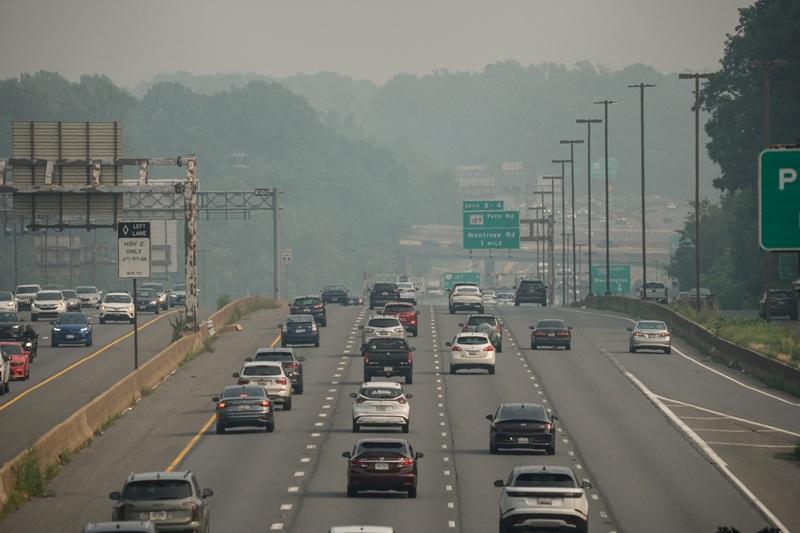
Smoke and Tension: The Wildfire Fallout between the U.S. and Canada
OTTAWA, Canada – In a fiery statement on Friday, President Donald Trump pointed the finger at Canada for the haze of wildfire smoke that has enveloped the United States, stretching from the Midwest to the Northeast. The air outdoors has become thick with ash, prompting health warnings and urging residents to stay inside.
Trump’s frustration was palpable as he announced plans to impose additional tariffs on Canadian goods, citing the “incalculable cost” of addressing the pollution. In a post on Truth Social, he declared, “We are holding Canada responsible for the fact that they are not properly maintaining their forests… the United States is being unnecessarily invaded by filthy, polluted, and unhealthy air.”
With a tone that reflected deep concern, he called the situation “totally unacceptable,” promising to reach out to Canadian Prime Minister Mark Carney. The two leaders have a rocky history, and it seems their relationship only adds fuel to the fire.
Trump described the unfolding crisis as “willful negligence,” bringing to light a point that both nations can agree on: the increasing frequency of wildfires has put a severe strain on resources, costing the United States billions each year.
Yet, climate experts paint a broader picture. They argue that rising temperatures have made forests drier and more prone to wildfires than ever before. “As our climate warms, we’re seeing more conducive hot, dry, windy, and extreme weather,” explained Mike Flannigan, a professor of wildland fire at Thompson Rivers University in British Columbia. He cautioned, “We’re going to see more fire.”
In 2025, shortly after taking office, Trump imposed tariffs on essential imports from Canada. Interestingly, in the midst of the controversy, Carney criticized the U.S. for not doing enough to combat climate change, which he believes is driving these increasingly extreme conditions.
The two leaders are set to meet this Sunday at the FIFA World Cup final in New Jersey, amidst a backdrop of raging wildfires.
As Canada battles the flames, statistics tell a grim story. Currently, about 650,000 acres (2,630 sq km) are ablaze across the country—a stark increase from 600,000 acres during the same time last year. Thousands of people have been evacuated, their lives disrupted.
In Ontario, the Namaygoosisagagun First Nation, also known as Collins First Nation, faced utter devastation. Community Incident Commander Matthew Hoppe shared a heartbreaking account: “There was nothing remaining. So as you can imagine, the membership is totally distraught, upset, overwhelmed, lost.”
Thunder Bay, a city of approximately 110,000 people, has reached full capacity housing evacuees from the region. Mayor Ken Boshcoff expressed the urgent need for support as the city stands with open arms during this crisis.
Ontario Premier Doug Ford announced that the province would be purchasing 11 new aircraft to assist in fighting these fast-spreading wildfires. He also voiced concern over U.S. politicians criticizing Canada’s firefighting efforts, defending the province’s commitment to combating the crisis.
To add to the chaos, the United States itself is grappling with unusually high wildfire activity this year, having already lost 3.7 million acres—far surpassing the 10-year average of 2.7 million.
As the smoke continues to linger and tensions rise, both nations must confront the reality of climate change and its far-reaching effects. The need for cooperation has never been more urgent. In the face of adversity, perhaps this crisis could serve as a reminder that collaboration, not conflict, is essential for a healthier future.