

It was supposed to be a night of celebration.
Bright lights. Familiar faces. More than 2,000 guests gathered for one of Washington’s most anticipated events — the White House Correspondents’ Dinner.
Then… everything changed.
In a matter of moments, chaos broke out.
The suspect behind the shooting that shook the press gala has now been identified — a 31-year-old man from California.
His name: Cole Tomas Allen.
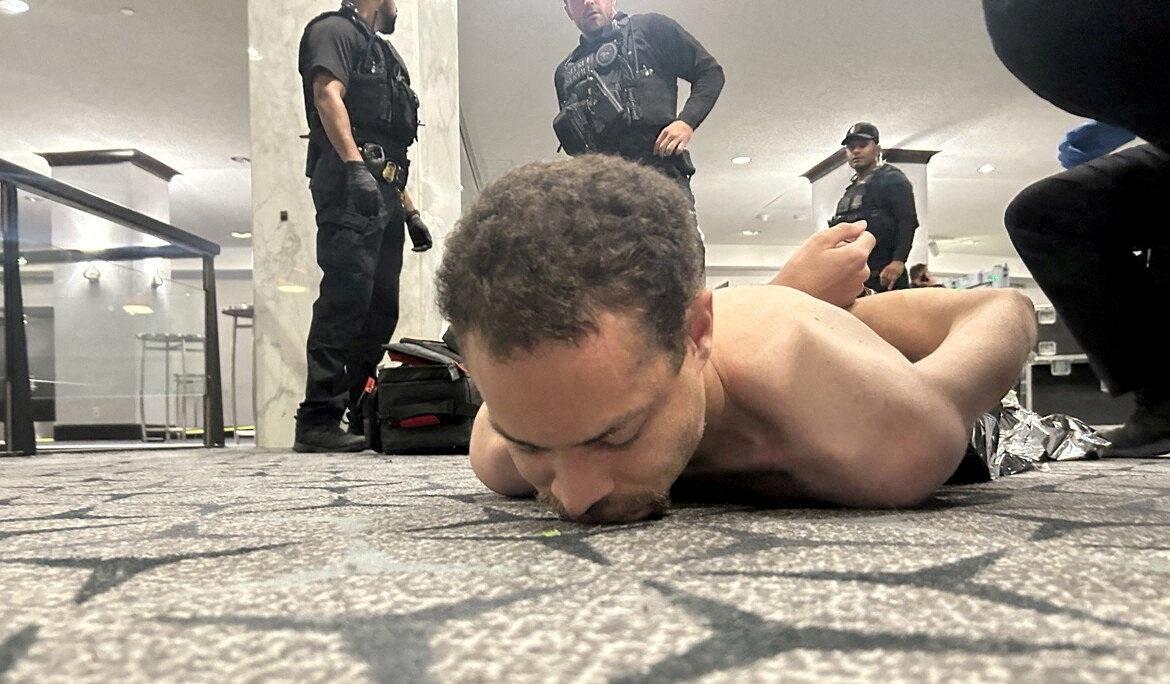
Just hours after the incident, a striking image surfaced. The man lay face down on the carpeted floor of the Washington Hilton — handcuffed, subdued — one level below where the event was unfolding.
A chilling contrast.
Upstairs, a night of prestige.
Downstairs, a scene of tension and fear.
According to law enforcement sources, Allen is from Torrance, California. On paper, his life told a different story.
Educated. Accomplished. Quiet.
A LinkedIn profile believed to be his described him as a mechanical engineer and computer scientist — even an independent game developer.
He reportedly graduated from the prestigious California Institute of Technology in 2017 — a fact later confirmed by the university.
He was also part of campus groups. A student. A teacher. Someone who, at one point, blended in.
But something changed.
In an interview, President Donald Trump described him bluntly: “a sick guy.”
“He had a lot of hatred in his heart for quite a while,” Trump said.
Those words linger.
Because behind the headlines, investigators are now piecing together a deeper, more disturbing picture.
Authorities say Allen attempted to rush past security — armed with a shotgun, a handgun, and multiple knives. A confrontation followed. Shots were exchanged before he was finally subdued.
It could have been worse.
Much worse.
What’s even more troubling is what he left behind.
A manifesto.
According to reports, it contained strong anti-Christian sentiments and deep anger toward the government. Investigators also reviewed a message he allegedly sent to his family shortly before the attack.
In it, he expressed outrage — over war, policy decisions, and long-standing controversies.
A buildup of frustration. Of belief. Of something darker.
Online traces reveal similar patterns.
A now-deleted account linked to him showed repeated posts criticizing the administration — sharp, emotional, and increasingly intense.
Meanwhile, back in Torrance, a quiet suburban home became the center of a federal investigation.
Police lights flashing.
Neighbors watching.
Questions hanging in the air.
Those who lived nearby described seeing him around — nothing out of the ordinary.
Just another face in the neighborhood.
But inside that ordinary life were pieces that didn’t quite fit.
Last year, Allen posted about completing his master’s degree in computer science. He also shared updates about a game he developed — something he described as “non-violent.”
He even worked as a part-time teacher at a tutoring center — once recognized as “teacher of the month.”
A different image.
A different story.
And yet, both exist.
Now, as he faces firearm and assault charges in court, investigators continue to ask the same question many are still trying to understand:
How does someone go from building a life… to breaking it apart in an instant?
For now, one thing is certain.
What happened that night wasn’t just an attack on an event.
It was a moment that exposed how quickly everything can change — and how much we still don’t fully see.