


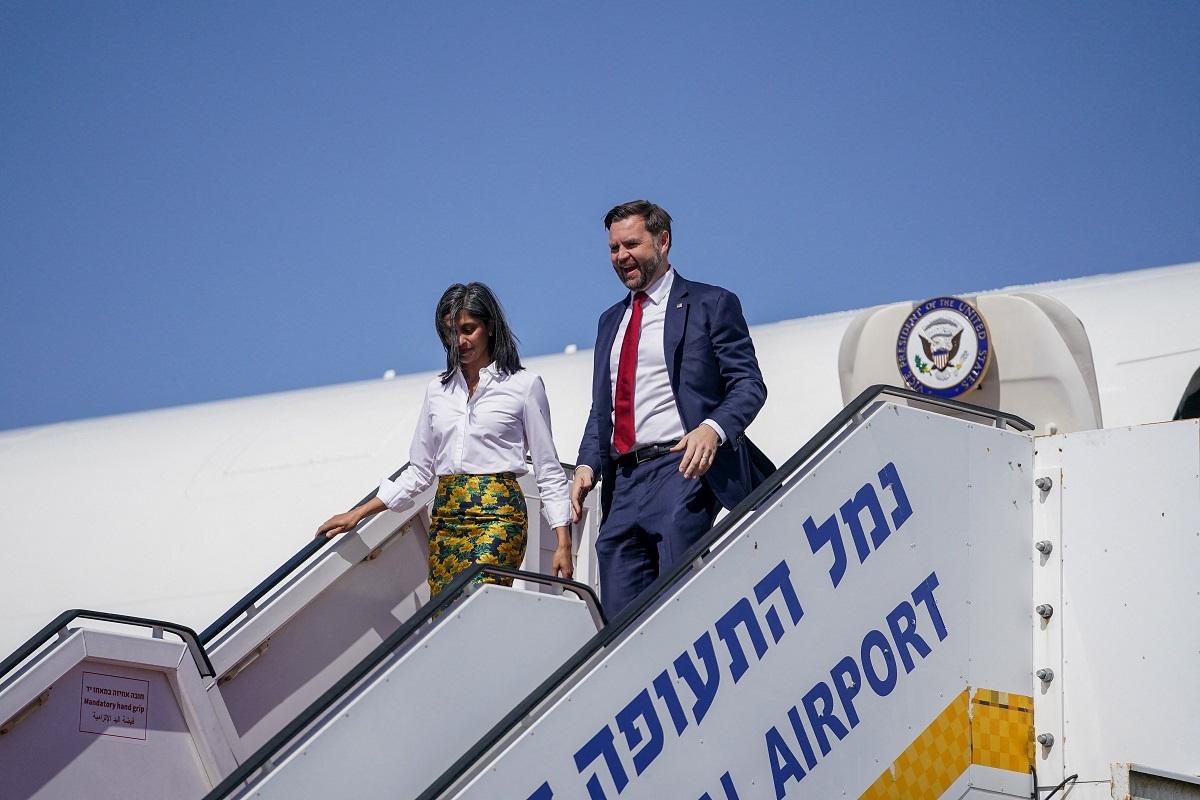
JERUSALEM/CAIRO — In a tense diplomatic mission, US Vice President JD Vance arrived in Israel on Tuesday to help stabilize the fragile Gaza ceasefire and push both Israel and Hamas toward deeper concessions under President Donald Trump’s 20-point peace plan.
The ceasefire, just eight days old, has been repeatedly tested. Both sides have accused each other of violations — from delays in returning hostages’ bodies to disputes over border access and aid deliveries.
Yet, Washington is determined to keep the truce alive.
“The goal now is to move forward — to reach the second phase of the ceasefire,” a senior Israeli official said, noting that Vance’s visit aims to advance talks toward a more stable agreement.
A Fragile Path Toward Peace
Vance’s visit follows a series of high-level discussions between Israeli Prime Minister Benjamin Netanyahu, US envoys Steven Witkoff and Jared Kushner, and Egyptian mediators in Cairo.
At the heart of the talks is the question of Hamas disarmament — a demand Israel insists upon but one that Hamas has refused to accept. Meanwhile, Hamas leader Khalil al-Hayya is leading negotiations in Cairo to discuss post-war arrangements and the next steps for Gaza’s governance.
Egypt’s intelligence chief Hassan Mahmoud Rashad also met with Netanyahu and is set to meet with US officials, highlighting the delicate coordination among mediators from Egypt, Qatar, and Turkey.
But the ceasefire remains on shaky ground. Qatar, one of the main brokers, accused Israel of “continuous violations” on Tuesday, further complicating progress.
The Question of Hamas’ Future Role
Trump’s peace plan envisions a technocratic Palestinian committee — overseen by an international board — to manage Gaza, explicitly excluding Hamas from any governance role.
However, Palestinian officials said Hamas has tentatively agreed to such a committee, provided it has the group’s consent and coordination with the Palestinian Authority and other factions.
Still, Hamas’ recent actions on the ground tell a different story. Just last week, the group clashed with rival factions and publicly executed men accused of collaborating with Israel. Trump defended the actions, calling them a “necessary step,” though the US military’s Middle East command urged Hamas to end the violence immediately.
Vance is expected to visit the US-led joint command center coordinating Gaza stabilization efforts later today.
Bodies Returned, Aid Still Scarce
In an emotional statement aired on Egyptian television, Hamas’ Khalil al-Hayya reiterated the group’s commitment to the truce and promised to return the bodies of hostages still held in Gaza.
“Let their bodies return to their families, and let the bodies of our martyrs return to theirs, to be buried in dignity,” Hayya said.
Israel confirmed the return of one more hostage’s body on Monday, while 15 more are still believed to be in Gaza. Israel has also returned 165 Palestinian bodies since the ceasefire began.
Despite progress in humanitarian access, aid remains critically low. The UN World Food Programme reported that supplies are increasing but still fall far short of its 2,000-ton daily target, with none yet reaching northern Gaza, where famine conditions persist.
Violence Still Shadows the Ceasefire
Fighting continues along the so-called “yellow line,” marking Israel’s military pullback. On Tuesday, Israeli forces reportedly shot and killed a man who crossed the line, underscoring the fragile calm.
The Gaza Health Ministry said at least seven Palestinians were killed by Israeli fire in the past 24 hours, bringing the total death toll since the war began to 68,229.
Hamas’ October 7, 2023, attack on Israel — which sparked the conflict — killed around 1,200 people, with 251 hostages dragged into Gaza.
Now, as JD Vance navigates his high-stakes mission, the world watches — hoping this fragile ceasefire can survive long enough to become something more: a path to peace.