

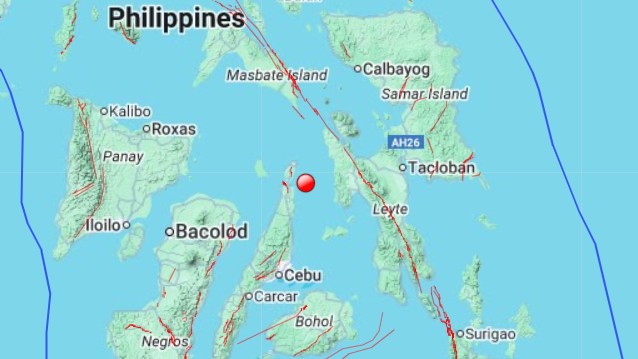
CEBU, Philippines — The 6.9-magnitude earthquake that struck Bogo City, Cebu on Tuesday, claiming the lives of 63 people, was caused by a fault that had not moved for centuries, experts revealed.
In a press briefing, Dr. Winchelle Ian Sevilla, chief of PHIVOLCS’ Seismological Observation and Earthquake Prediction Division, said the culprit was an offshore fault that had lain still for at least 400 years.
“At least in the last 400 years, the fault only moved again now. Because it stayed quiet so long, the quake turned out stronger,” Sevilla explained.
PHIVOLCS said the fault currently remains unnamed, but has already been tagged as an offshore fault since it is located under the sea. A quick response team has been deployed to study it further.
A Land of Shaking Ground
Cebu and its neighboring provinces sit in one of the country’s most earthquake-prone regions. Aside from the newly identified offshore fault, PHIVOLCS listed several known seismic sources: the Bogo Fault, the Daanbantayan Lineament, and the Cebu Fault System.
The region is also surrounded by local inland and offshore faults, some hidden beneath younger deposits, all capable of producing quakes of varying strength.
A History of Major Quakes
This week’s disaster is not the first. PHIVOLCS records show at least eight significant earthquakes with magnitudes between 5.0 and 7.2 have shaken Cebu and nearby provinces from 1885 to 2013.
Among the most devastating were the 6.9 quake in Negros Oriental in 2012 and the 7.2 earthquake in Bohol in 2013.
A Painful Reminder
For many, Tuesday’s quake is a chilling reminder of the country’s vulnerability. Behind the statistics are stories of lost homes, families in mourning, and communities now rebuilding from the rubble.
As investigations continue, PHIVOLCS urges vigilance, preparedness, and awareness — because in a land of faults, the ground beneath us can never be taken for granted.