


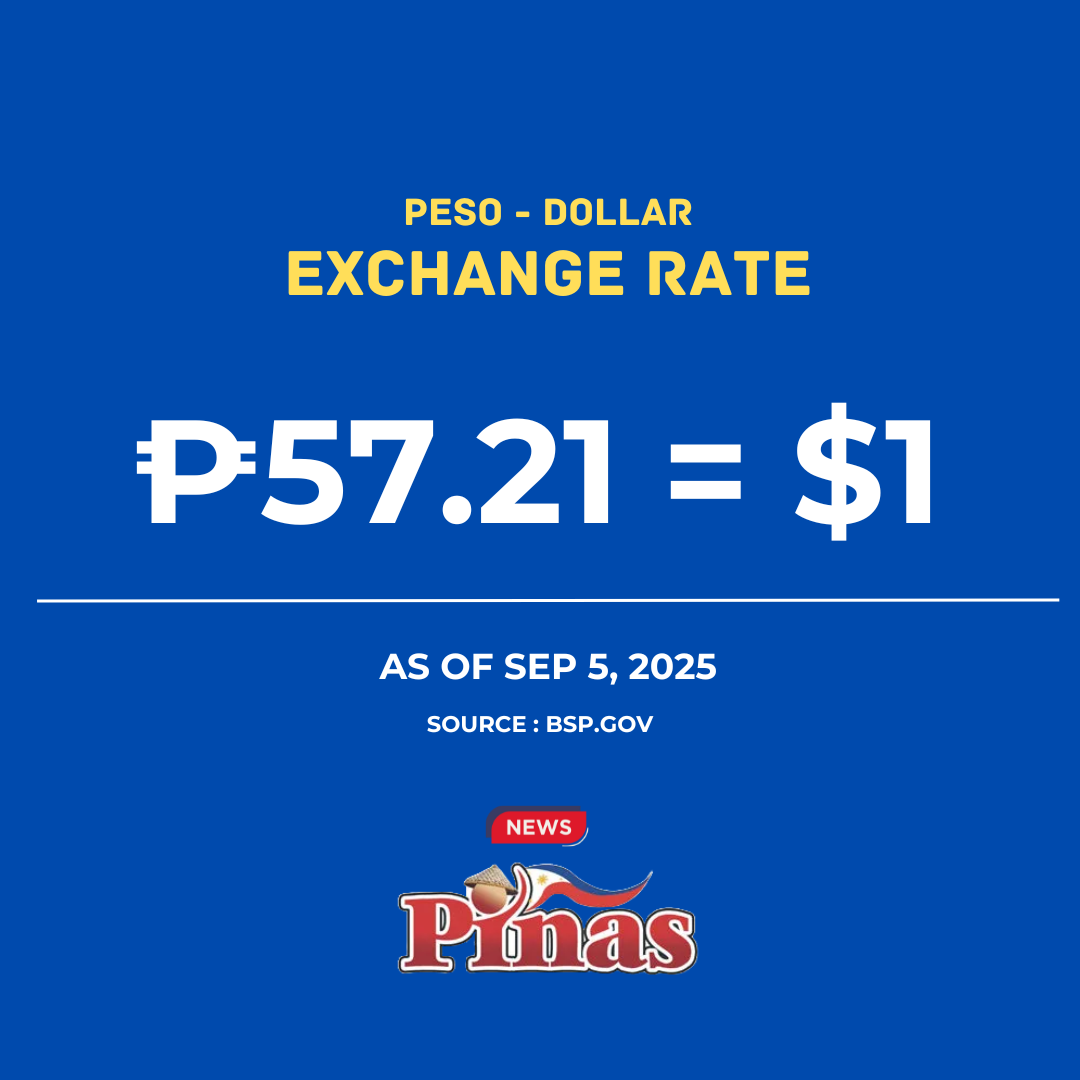
The Philippine peso opened Friday, September 5, 2025, on a cautious note as the Bangko Sentral ng Pilipinas (BSP) released its latest reference exchange rate bulletin. The peso was set at ₱57.00 per U.S. dollar, with a buying rate of ₱56.75 and a selling rate of ₱57.25.
The peso’s movement reflects global market jitters, with traders watching inflation data, oil prices, and geopolitical tensions. Here’s how the top 15 currencies are performing against the peso:
-
US Dollar (USD) – ₱57.21
The greenback remains firm, showing the peso’s slight weakness as investors continue to flock to the dollar as a safe haven. -
Japanese Yen (JPY) – ₱0.39
The yen stays weak, reflecting Japan’s ongoing loose monetary policy. A single peso still buys multiple yen. -
British Pound (GBP) – ₱76.86
The pound stays strong and one of the most expensive currencies for Filipinos, driven by higher UK interest rates. -
Hong Kong Dollar (HKD) – ₱7.33
Pegged closely to the US dollar, the HKD remains stable, mirroring dollar movements. -
Swiss Franc (CHF) – ₱71.03
A traditional safe-haven currency, the franc remains costly, showing global investors’ cautious mood. -
Canadian Dollar (CAD) – ₱41.40
The loonie is steady, helped by oil prices, as Canada is a major exporter. -
Singapore Dollar (SGD) – ₱44.36
Strong regional performance keeps the Singapore dollar firm, reflecting the city-state’s economic resilience. -
Australian Dollar (AUD) – ₱37.27
The Aussie remains soft amid slower growth in China, one of its biggest trade partners. -
Bahraini Dinar (BHD) – ₱151.77
Still one of the world’s most expensive currencies, driven by Bahrain’s strong oil-backed economy. -
Kuwaiti Dinar (KWD) – N/A
No official peso equivalent was published today, but it traditionally holds the title of the strongest currency globally. -
Saudi Riyal (SAR) – ₱15.25
Important for millions of OFWs in the Middle East, the riyal remains stable as it is pegged to the US dollar. -
Brunei Dollar (BND) – ₱44.19
Moves closely with the Singapore dollar, given their monetary agreement. -
Indonesian Rupiah (IDR) – ₱0.0035
The weakest among the top currencies; it takes hundreds of rupiah to equal just one peso. -
Thai Baht (THB) – ₱1.77
The baht holds steady, reflecting Thailand’s tourism recovery and regional trade strength. -
UAE Dirham (AED) – ₱15.58
Another key Middle East currency for OFWs, the dirham stays firm as it is pegged to the US dollar.
Meanwhile, the Euro (EUR) stands at ₱66.65, while the Chinese Yuan (CNY) is at ₱8.01, both showing stability despite global uncertainties.
On commodities, gold prices surged to $3,552.95 per ounce, signaling strong safe-haven demand, while silver traded at $40.70.
The peso’s mild weakness shows the Philippines is not immune to global shocks. For OFWs and businesses, this means remittances gain more peso value, but imports and oil could get more expensive in the coming weeks.