


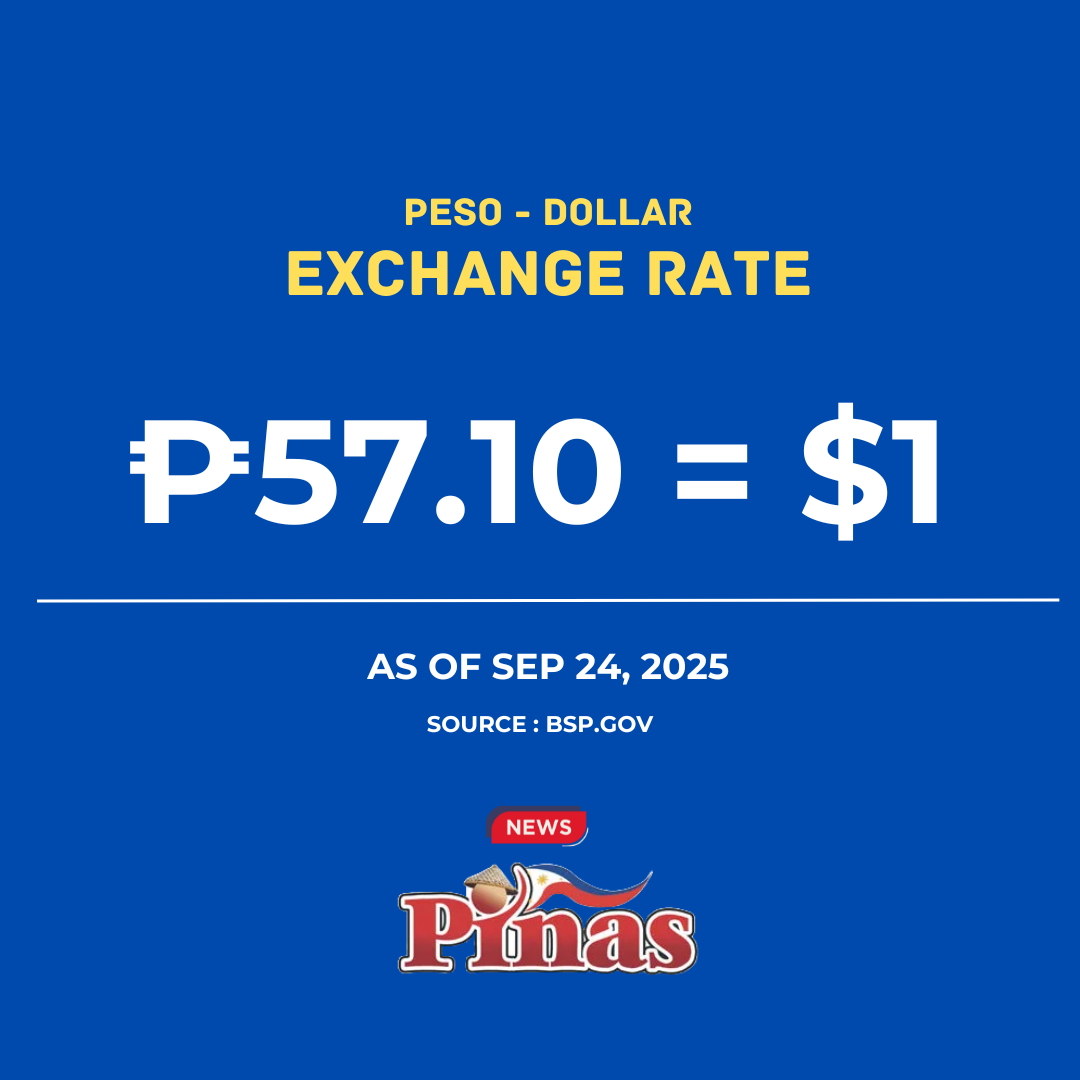
The Bangko Sentral ng Pilipinas (BSP) has released its latest Reference Exchange Rate Bulletin, giving Filipinos a snapshot of how the peso is performing against the world’s biggest currencies.
For overseas workers sending money home, travelers planning trips, or businesses trading abroad, these numbers tell a powerful story about strength, weakness, and global shifts.
Let’s break down the top 15 currencies and what they mean for the peso:
1. US Dollar (USD) – ₱57.10
The US dollar remains the benchmark. At ₱57.10 per $1, the peso is holding steady but still shows the dollar’s strong pull in global trade.
2. Japanese Yen (JPY) – ₱0.3870
The yen continues to stay weak. For Filipinos in Japan, this means remittances carry less peso value, but Japanese goods are cheaper to import.
3. British Pound (GBP) – ₱77.22
The pound remains one of the strongest currencies. Every pound now fetches ₱77.22, making the UK one of the most expensive places for Filipinos.
4. Hong Kong Dollar (HKD) – ₱7.34
Still popular among OFWs, the HK dollar trades at ₱7.34, giving overseas workers in Hong Kong a decent edge when sending money back.
5. Swiss Franc (CHF) – ₱72.19
A powerhouse of stability, the franc is valued at ₱72.19. Swiss currency often strengthens during global uncertainty—signaling investors are cautious.
6. Canadian Dollar (CAD) – ₱41.27
The Canadian dollar holds at ₱41.27. For Filipinos in Canada, this exchange rate means remittances remain solid, though not as high as before.
7. Singapore Dollar (SGD) – ₱44.51
Singapore stays strong at ₱44.51. With many OFWs based there, this is good news for remittance families in the Philippines.
8. Australian Dollar (AUD) – ₱37.67
The Aussie dollar trades at ₱37.67, a steady rate but softer compared to other Western currencies.
9. Bahraini Dinar (BHD) – ₱151.44
One of the world’s strongest currencies, the Bahraini dinar equals a massive ₱151.44. For OFWs in Bahrain, this brings big value at home.
10. Kuwaiti Dinar (KWD) – N/A
The Kuwaiti dinar, usually the strongest currency in the world, has no available rate listed today. This may be due to market timing or data gaps.
11. Saudi Riyal (SAR) – ₱15.22
With millions of Filipinos in Saudi Arabia, this matters greatly. At ₱15.22, remittances continue to fuel families across the Philippines.
12. Brunei Dollar (BND) – ₱44.34
Close to the Singapore dollar, the Brunei dollar stands at ₱44.34, another strong currency for OFWs in Southeast Asia.
13. Indonesian Rupiah (IDR) – ₱0.0034
The rupiah remains weak, trading at just ₱0.0034. This makes Indonesia one of the cheapest neighboring economies for Philippine traders.
14. Thai Baht (THB) – ₱1.79
The baht trades at ₱1.79. It’s not as strong as Western currencies, but Thailand remains competitive in tourism and trade with the Philippines.
15. UAE Dirham (AED) – ₱15.55
A key currency for millions of OFWs, the UAE dirham stands at ₱15.55—a strong and stable remittance currency for Filipinos in Dubai and Abu Dhabi.
Bigger Picture: Where the Peso Stands
-
BSP reference rate sits at ₱57.30 per dollar, signaling stability.
-
Gold prices are up at $3,760.75, reflecting global uncertainty.
-
Silver also climbs to $43.90, showing safe-haven demand.
💡 What this means for Filipinos:
-
If you’re an OFW in the Middle East or Europe, your remittances have strong peso value right now.
-
If you’re in Japan, the weaker yen may hurt remittances—but it benefits Filipino businesses importing Japanese products.
-
For traders and investors, the peso’s relative stability against the US dollar gives some breathing room in a volatile global market.
👉 In short: the peso is stable but overshadowed by stronger currencies like the pound, franc, and dinar. For families relying on remittances, today’s numbers show just how much the global economy touches everyday Filipino lives.