


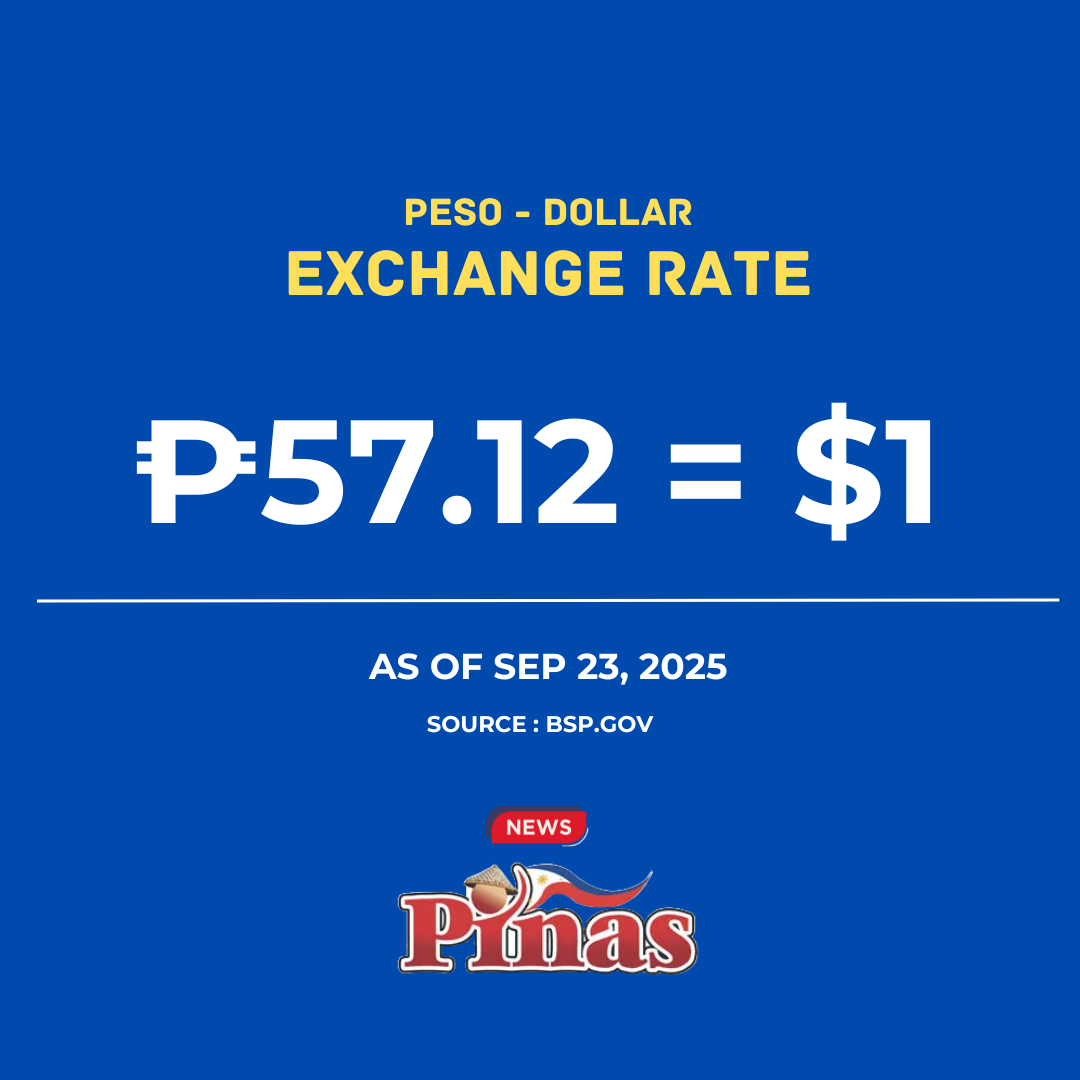
September 23, 2025 — The Bangko Sentral ng Pilipinas (BSP) has released its latest foreign exchange bulletin, giving Filipinos a snapshot of how the peso stacks up against the world’s most important currencies.
At the center of it all, the US dollar remains king, holding steady at ₱57.12. This means that every time the greenback strengthens, imported goods—from fuel to technology—could get more expensive for Filipinos.
Let’s break down what’s happening with the top 15 currencies and what it means for us:
1. US Dollar (USD) – ₱57.12
The dollar is still the benchmark. Strong and steady, it continues to put pressure on the peso.
2. Japanese Yen (JPY) – ₱0.39
The yen remains weak, making Japanese goods cheaper for Filipinos. But it’s also a sign of Japan’s ongoing economic struggles.
3. British Pound (GBP) – ₱77.22
The pound is surging. If you have relatives in the UK sending remittances, they’re worth more pesos today.
4. Hong Kong Dollar (HKD) – ₱7.35
Still a regional heavyweight, the HK dollar’s stability benefits overseas workers and businesses trading through Hong Kong.
5. Swiss Franc (CHF) – ₱72.10
Known as a “safe haven” currency, the franc remains strong, reflecting Switzerland’s steady economy.
6. Canadian Dollar (CAD) – ₱41.33
The “loonie” is relatively stable, but still cheaper compared to the US dollar.
7. Singapore Dollar (SGD) – ₱44.56
Singapore’s currency remains one of Asia’s strongest, signaling its resilience in trade and finance.
8. Australian Dollar (AUD) – ₱37.67
Softer than its Asian peers, but still attractive for those working down under sending money home.
9. Bahrain Dinar (BHD) – ₱151.55
One of the most powerful currencies in the world. A single dinar goes a very long way in pesos.
10. Kuwait Dinar (KWD) – N/A
The world’s strongest currency usually tops the list, but today’s equivalent wasn’t published.
11. Saudi Riyal (SAR) – ₱15.24
A crucial currency for millions of OFWs in the Middle East, the riyal remains steady.
12. Brunei Dollar (BND) – ₱44.39
Mirroring Singapore’s strength, Brunei’s dollar is robust and stable.
13. Indonesian Rupiah (IDR) – ₱0.0034
Extremely low value, but Indonesia’s economy relies on scale and domestic strength, not currency might.
14. Thai Baht (THB) – ₱1.80
Thailand’s baht is holding steady, reflecting its growing tourism and export industries.
15. UAE Dirham (AED) – ₱15.55
Another lifeline for OFWs, especially in Dubai and Abu Dhabi. Strong and reliable.
Bigger Picture
The euro sits at ₱67.41, reminding us how expensive life in Europe can be. Meanwhile, Asian currencies like the Chinese yuan (₱8.03) and Korean won (₱0.041) show the region’s diverse economic realities.
The BSP’s reference rate stands at ₱57.05, close to yesterday’s closing of ₱57.06, showing stability in peso-dollar trading.
Gold prices are soaring at $3,746.80, and silver sits at $43.95, reflecting global investors’ search for safe havens in uncertain times.
Why This Matters
For Filipinos, these numbers aren’t just statistics. They affect remittances from OFWs, the cost of imported goods, and the strength of the peso in everyday life.
When the dollar rises, we feel it in fuel prices, grocery bills, and even gadgets. But for families receiving pounds, dinars, or riyals, today’s rates could mean more food on the table.