


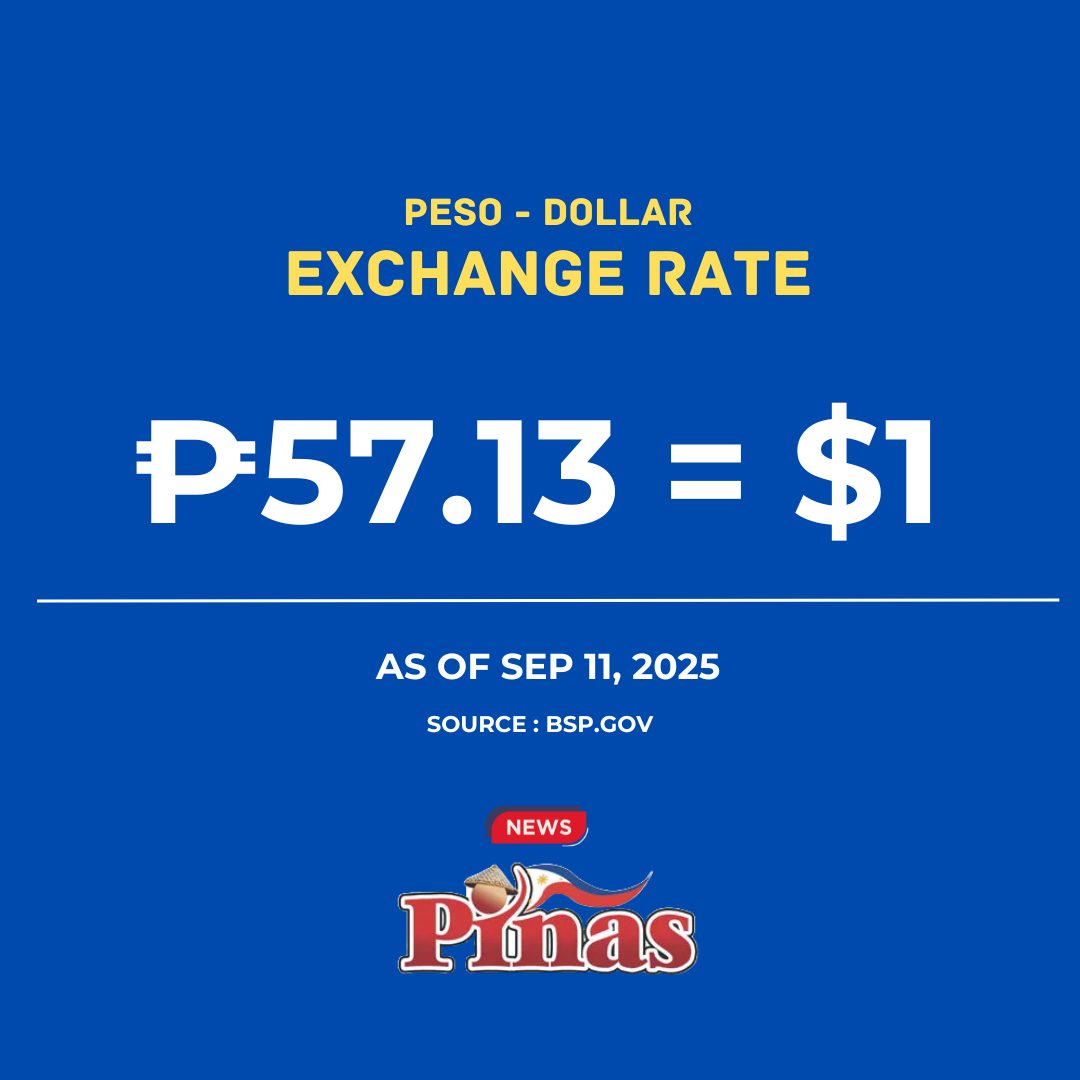
On September 11, 2025, the Bangko Sentral ng Pilipinas (BSP) released its daily reference exchange rate bulletin. The peso remains under pressure, trading at ₱57.13 to $1, showing the continuing strength of the U.S. dollar against most currencies worldwide.
But behind this headline figure, every major currency tells a story — of global trade, politics, and the everyday struggles of Filipinos abroad.
The Dollar’s Grip (USD – ₱57.13)
The U.S. dollar remains the anchor of the global economy. At ₱57.13, it continues to be the benchmark for overseas Filipinos sending money home and for businesses that rely heavily on imports. Its strength signals both stability and pressure on weaker economies.
Yen at Its Weakest (JPY – ₱0.39)
Japan’s yen continues to slide, worth only ₱0.39 per unit. For Filipinos in Japan, this means remittances are worth less in pesos, making life back home a little tighter for their families.
The Pound Holds Value (GBP – ₱77.33)
The British pound remains one of the strongest currencies, trading at ₱77.33. This is good news for overseas workers in the UK, as their money stretches further when sent to the Philippines.
Hong Kong Dollar Steady (HKD – ₱7.33)
The Hong Kong dollar sits at ₱7.33. It’s stable, but not as strong as other currencies, affecting Filipino workers in the region who rely on consistent exchange rates.
Swiss Franc a Safe Haven (CHF – ₱71.53)
At ₱71.53, the Swiss franc remains a safe haven currency, backed by Switzerland’s reputation for stability. Strong for investors, but costly for imports.
Canadian Dollar (CAD – ₱41.21)
Canada’s dollar trades at ₱41.21. It’s weaker than the pound and franc but still gives overseas Filipinos in Canada a solid conversion rate.
Singapore Dollar (SGD – ₱44.56)
At ₱44.56, the Singapore dollar stays strong. For thousands of OFWs in Singapore, this remains a reliable and powerful source of remittances.
Australian Dollar (AUD – ₱37.77)
Australia’s dollar is at ₱37.77, slightly weaker than Singapore’s, but still holding firm. For Filipino families relying on OFW remittances from Australia, it’s steady support.
Bahrain Dinar (BHD – ₱151.54)
The Bahraini dinar is among the strongest in the world, with one unit equal to a staggering ₱151.54. Filipino workers in Bahrain send home some of the most valuable remittances because of this strength.
Kuwaiti Dinar (KWD – N/A)
The Kuwaiti dinar, often the strongest global currency, was not available in today’s bulletin. Historically, it outvalues even the Bahraini dinar, making it a lifeline for many OFWs in Kuwait.
Saudi Riyal (SAR – ₱15.23)
The Saudi riyal remains critical for Filipinos in the Middle East. At ₱15.23, it provides a consistent stream of remittances, especially from OFWs in the oil industry.
Brunei Dollar (BND – ₱44.40)
Similar to Singapore’s, the Brunei dollar is ₱44.40. With many Filipinos working in Brunei, this gives them strong purchasing power for families back home.
Indonesian Rupiah (IDR – ₱0.0035)
The Indonesian rupiah trades at less than half a centavo (₱0.0035). While weak, its role in regional trade still makes it significant for the Philippines.
Thai Baht (THB – ₱1.80)
The Thai baht is at ₱1.80. Stronger than the rupiah but far from the peso’s biggest movers, it reflects Thailand’s resilient economy despite global challenges.
UAE Dirham (AED – ₱15.55)
The UAE dirham stays strong at ₱15.55. With a massive Filipino community in Dubai and Abu Dhabi, this is one of the most important currencies for remittances.
What This Means for Filipinos
The peso’s weakness against the dollar means imported goods may cost more, but on the flip side, OFWs earning in strong currencies like the pound, dinar, and dirham will bring home more value in pesos.
At the same time, currencies like the yen and rupiah highlight the struggles of OFWs whose earnings don’t stretch as far when converted.
In the end, the peso’s ₱57.13 exchange rate is not just a number—it’s a daily reality for millions of Filipinos navigating the balance between global markets and family survival.