


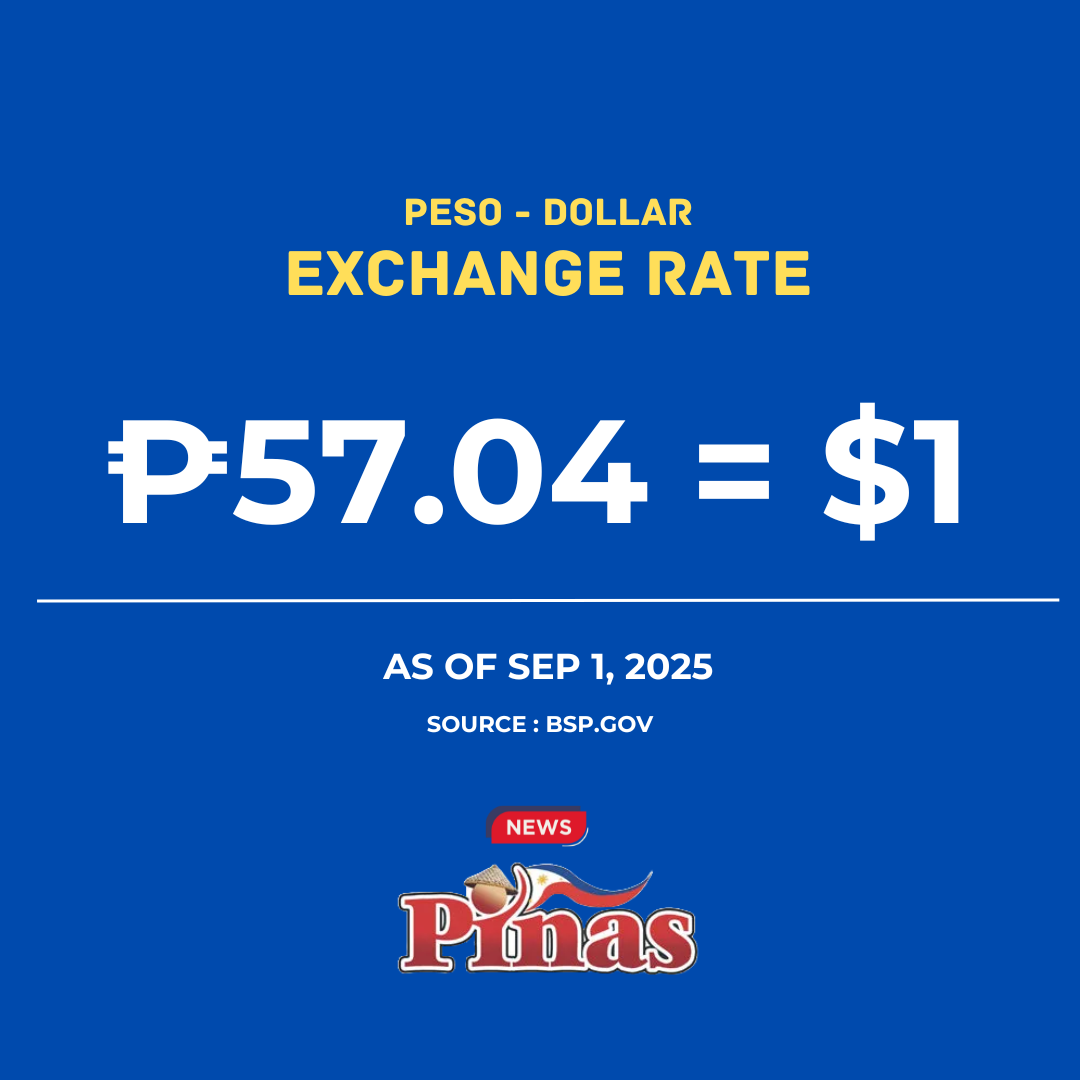
The Bangko Sentral ng Pilipinas (BSP) released its latest exchange rate bulletin on September 1, 2025, showing how the Philippine peso is performing against the world’s top currencies.
The peso closed at ₱57.04 against the US dollar, nearly steady compared to the previous PDS closing rate of ₱57.13 last week. The BSP’s reference rate was set at ₱57.15.
Here’s a closer look at the top 15 currencies and what’s happening:
-
US Dollar (USD) – At ₱57.04, the dollar remains strong and continues to be the key benchmark for global trade.
-
Japanese Yen (JPY) – Weak at ₱0.39 per yen, showing how far the yen has slid compared to the peso in recent years.
-
British Pound (GBP) – Strong at ₱77.05, the pound remains one of the most expensive currencies against the peso.
-
Hong Kong Dollar (HKD) – At ₱7.32, the HK dollar is stable, closely moving with the US dollar’s direction.
-
Swiss Franc (CHF) – At ₱71.33, the franc is one of the safest-haven currencies, still very expensive compared to the peso.
-
Canadian Dollar (CAD) – At ₱41.52, the loonie continues to show moderate strength.
-
Singapore Dollar (SGD) – Trading at ₱44.45, the SGD stays firm as Asia’s financial hub currency.
-
Australian Dollar (AUD) – At ₱37.31, the Aussie dollar remains weaker compared to its stronger peers.
-
Bahraini Dinar (BHD) – The most expensive in the list, hitting ₱151.31 per dinar.
-
Kuwaiti Dinar (KWD) – Data not available for the day, but traditionally one of the highest-valued currencies globally.
-
Saudi Riyal (SAR) – At ₱15.20, key for millions of OFWs sending remittances home.
-
Brunei Dollar (BND) – Nearly identical to the Singapore dollar, at ₱44.27.
-
Indonesian Rupiah (IDR) – Very low at ₱0.0035 per rupiah, reflecting its large denomination structure.
-
Thai Baht (THB) – At ₱1.77, the baht remains stable in the ASEAN region.
-
UAE Dirham (AED) – Strong at ₱15.53, another critical remittance currency for overseas Filipinos.
Meanwhile, the euro stood at ₱66.68, making it stronger than the US dollar.
On the commodities side, gold was valued at $3,443.75 per ounce, while silver was priced at $39.80.
These numbers matter for Filipinos—especially OFWs, importers, and exporters—because every shift in the peso’s value directly affects remittances, business costs, and household spending.