


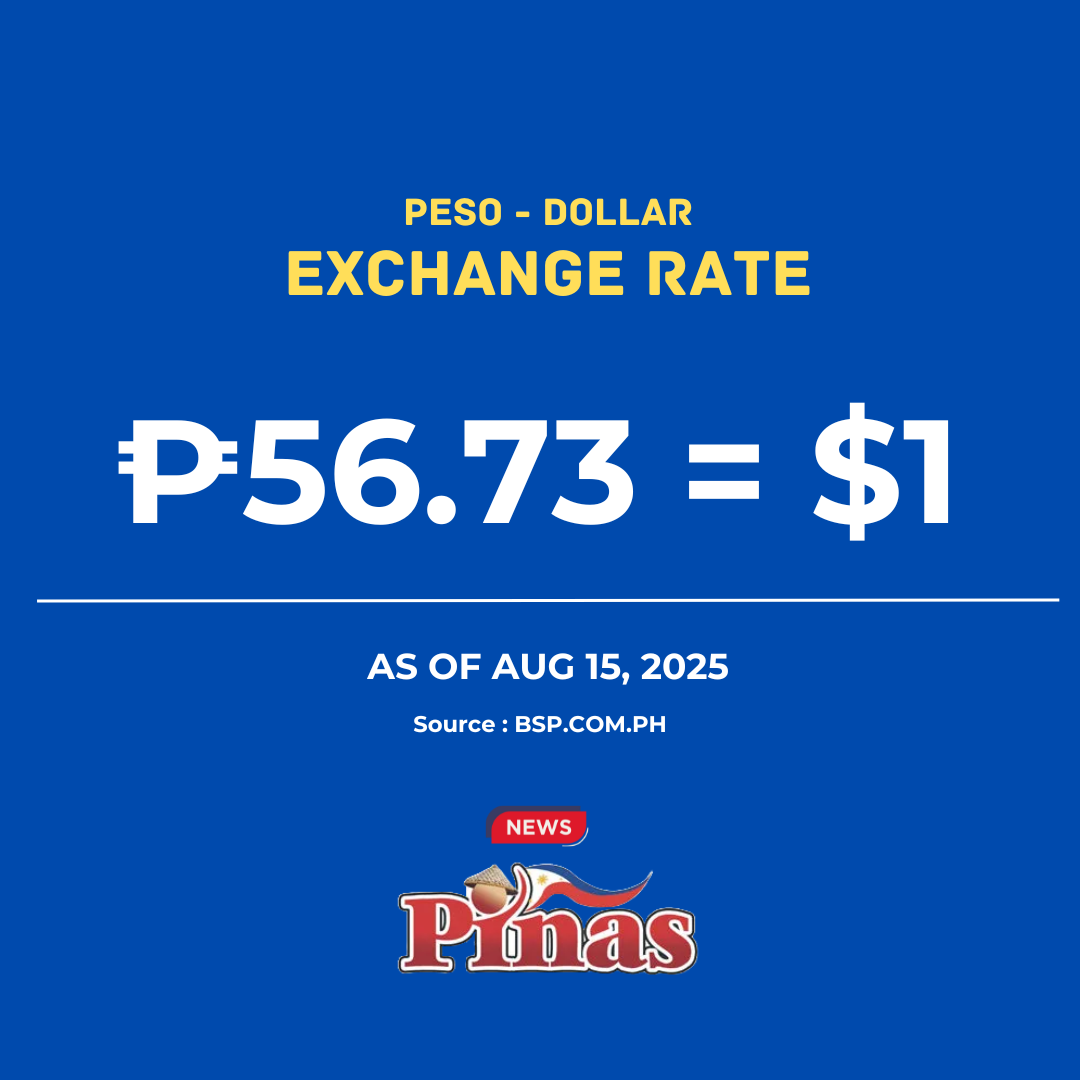
Have you ever wondered how much your peso is worth compared to dollars, yen, or pounds today? The Bangko Sentral ng Pilipinas (BSP) just released its latest exchange rate bulletin for August 15, 2025, and the results show how the world’s top currencies are moving.
Exchange rates tell us how much money from one country is worth in another country’s money. If a currency is strong, you get less of it for your peso. If it’s weak, you get more. Let’s break down the top 15 currencies in the list — and see which ones are winning and which ones are losing against the peso.
1. United States Dollar (USD) – ₱56.73 per $1
The US dollar is still the world’s most powerful currency for trade and travel. If you need $1, you have to give ₱56.73. That means the peso is a lot weaker than the dollar, making imports from the US more expensive.
2. Japanese Yen (JPY) – ₱0.384 per ¥1
The yen is much smaller in value than the peso, so you get more yen for your money. But for people sending money to Japan, this means you need more pesos to get the same amount of yen compared to a few years ago.
3. British Pound (GBP) – ₱76.78 per £1
The pound is one of the strongest currencies in the world. Traveling to the UK or buying British goods? You’ll need a lot of pesos because £1 costs nearly ₱77.
4. Hong Kong Dollar (HKD) – ₱7.24 per HK$1
Popular among OFWs in Hong Kong, this currency stays fairly stable. ₱7.24 for every HK dollar means remittances can still bring decent value back home.
5. Swiss Franc (CHF) – ₱70.25 per CHF 1
Switzerland’s currency is strong because the country is seen as safe for banking and investments. ₱70 for one franc makes Swiss goods and travel pricey.
6. Canadian Dollar (CAD) – ₱41.07 per CA$1
The Canadian dollar is weaker than the US dollar but still strong compared to the peso. OFWs in Canada sending money home benefit when the CAD is high.
7. Singapore Dollar (SGD) – ₱44.18 per SG$1
Singapore’s economy is stable, so its dollar stays strong. A single Singapore dollar costs over ₱44, showing the peso’s weaker side.
8. Australian Dollar (AUD) – ₱36.86 per AU$1
Australia’s currency is affected by trade in gold, iron, and coal. At nearly ₱37 per AU dollar, Filipinos in Australia can still send good value home.
9. Bahraini Dinar (BHD) – ₱150.53 per BHD 1
One of the strongest currencies on Earth! At over ₱150 for just 1 dinar, this is great for OFWs in Bahrain but makes imports from there very costly.
10. Kuwaiti Dinar (KWD) – N/A in this report
The Kuwaiti dinar is usually the world’s most valuable currency, but it’s not listed with a peso rate here.
11. Saudi Riyal (SAR) – ₱15.12 per SAR 1
With so many OFWs in Saudi Arabia, this currency is important. ₱15.12 for 1 riyal is a steady rate that helps families back home.
12. Brunei Dollar (BND) – ₱44.01 per BND 1
Almost the same as the Singapore dollar, since both are linked in value. It’s strong and stable.
13. Indonesian Rupiah (IDR) – ₱0.0035 per Rp 1
The rupiah is one of the weakest major Asian currencies. One peso can get you hundreds of rupiah, which is why prices in Indonesia look like huge numbers.
14. Thai Baht (THB) – ₱1.75 per THB 1
Thailand’s currency is steady, but still stronger than some in the region. ₱1.75 for 1 baht means the peso holds some ground here.
15. UAE Dirham (AED) – ₱15.45 per AED 1
The dirham is strong because it’s tied to the US dollar. This benefits the many OFWs in Dubai and Abu Dhabi who send money home.
What This Means for You:
-
If you’re an OFW, a strong foreign currency means more pesos when you send money home.
-
If you’re traveling or importing goods, a strong foreign currency means you’ll spend more pesos.
-
The peso is holding steady against some Asian neighbors but remains weak against top Western and Middle Eastern currencies.