
MANILA — It’s another telling day for the Philippine peso.
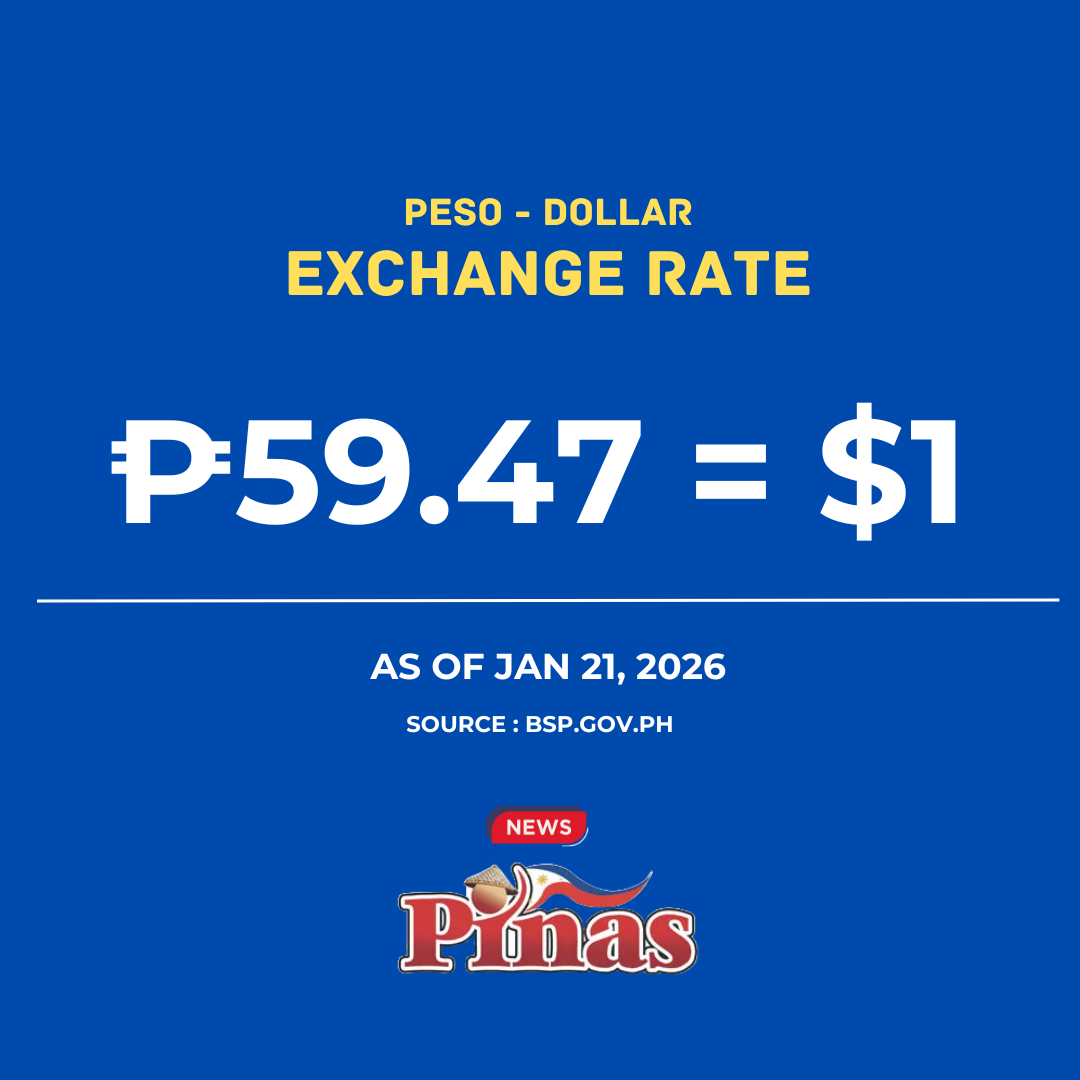
As of January 21, 2026, the Bangko Sentral ng Pilipinas (BSP) reference rate shows the peso at ₱59.45 against the US dollar, hovering close to the ₱59.5 level — a reminder of how global forces continue to shape local buying power.
Here’s what’s happening, simply explained, peso versus the world’s major currencies.
PHP vs US Dollar (USD): The Main Story
The US dollar stands at ₱59.477.
This means Filipinos need nearly ₱60 to buy one dollar — expensive for importers and travelers, but helpful for exporters and OFW remittances. The dollar remains strong, supported by global demand and safe-haven buying.
PHP vs Top Global Currencies (Top 15)
British Pound (GBP) – ₱79.93
The pound towers over the peso. UK currency remains one of the most expensive, reflecting strong valuation despite global uncertainty.
Euro (EUR) – ₱69.74
Europe’s common currency stays firm, still far stronger than the peso, making European travel and imports costly.
Swiss Franc (CHF) – ₱75.32
A classic safe haven. When markets feel uneasy, the franc holds its ground — and the peso feels the pressure.
Bahrain Dinar (BHD) – ₱157.81
One of the strongest currencies in the world. Against the peso, it’s not even close.
Singapore Dollar (SGD) – ₱46.34
Stronger than the peso but relatively stable. Singapore remains a key reference for regional strength.
Canadian Dollar (CAD) – ₱42.99
Commodity-backed and steady, the loonie still outpaces the peso comfortably.
Australian Dollar (AUD) – ₱40.06
The Aussie dollar remains resilient, supported by resources and trade.
Hong Kong Dollar (HKD) – ₱7.63
Because it’s pegged to the US dollar, it closely follows USD movements — and stays firm against PHP.
UAE Dirham (AED) – ₱16.19
Critical for OFWs. A strong dirham means remittances go further back home.
Saudi Riyal (SAR) – ₱15.86
Another OFW-relevant currency, steady and supportive for peso inflows.
Japanese Yen (JPY) – ₱0.38
The yen remains weak. For Filipinos, Japan is cheaper — but for exporters, margins are tight.
Thai Baht (THB) – ₱1.92
Regional rival currencies remain stronger than the peso, but not by a wide margin.
Chinese Yuan (CNY) – ₱8.55
Closely watched due to trade ties. A firm yuan adds pressure on Asian currencies, including PHP.
Brunei Dollar (BND) – ₱46.16
Moves closely with the Singapore dollar, staying strong versus the peso.
Indonesian Rupiah (IDR) – ₱0.0035
Both currencies face similar regional pressures, but the peso still trades higher.
What This Means for Filipinos
A weaker peso makes imports, fuel, and foreign travel more expensive — but boosts OFW remittances, BPO earnings, and exporters. It’s a balancing act that affects daily life, from groceries to plane tickets.
For now, the peso is holding — but just barely.
And as global markets shift, every centavo counts.