


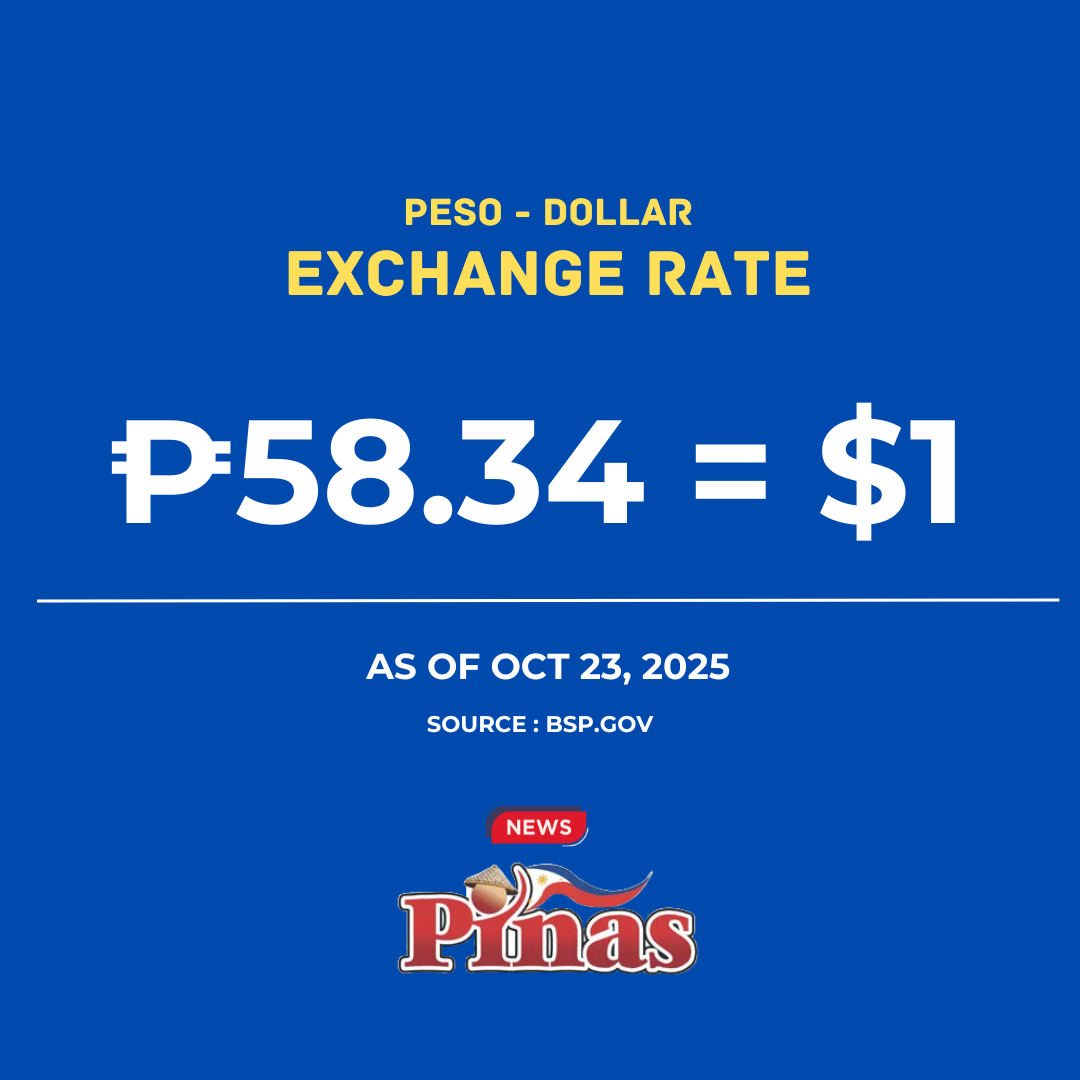
The Bangko Sentral ng Pilipinas (BSP) has just released its latest Foreign Exchange Rate Bulletin for October 23, 2025, and it’s giving a clear snapshot of how the world’s top currencies are performing against the Philippine peso.
Let’s break it down — and see what’s happening across the top 15 currencies shaping the global economy today.
🇺🇸 1. US Dollar (USD) — The Global Benchmark
The US dollar remains strong, standing at ₱58.34. It’s the currency that drives most international trade, and right now, it’s holding firm despite market volatility. For Filipinos working or trading abroad, this means the value of remittances stays solid — but imports might remain pricey.
🇯🇵 2. Japanese Yen (JPY) — Still Weak but Steady
The Japanese yen trades at ₱0.38, showing a continued struggle to gain momentum. Japan’s economic slowdown and deflationary pressure keep the yen subdued, but it’s stable compared to recent months.
🇬🇧 3. British Pound (GBP) — Among the Strongest
The British pound sits high at ₱77.93 — one of the strongest among major currencies. Despite inflation challenges, the UK’s currency continues to show resilience, a reflection of steady investor confidence.
🇭🇰 4. Hong Kong Dollar (HKD) — Backed by Stability
At ₱7.50, the Hong Kong dollar stays steady, largely thanks to its peg to the US dollar. It’s a small but powerful player in the Asian currency scene.
🇨🇭 5. Swiss Franc (CHF) — The Safe Haven
Known for stability, the Swiss franc is trading at ₱73.34. Investors often flock to this “safe haven” currency during times of uncertainty — and that’s still true today.
🇨🇦 6. Canadian Dollar (CAD) — Slight Dip Amid Oil Fluctuations
The Canadian dollar is valued at ₱41.69. Oil prices continue to shape its movement, as Canada’s economy heavily relies on energy exports.
🇸🇬 7. Singapore Dollar (SGD) — Asian Powerhouse
The Singapore dollar remains strong at ₱44.97, reflecting Singapore’s robust trade performance and disciplined financial policy. It’s one of Asia’s most stable currencies.
🇦🇺 8. Australian Dollar (AUD) — Slightly Lower, But Resilient
Trading at ₱37.85, the Aussie dollar has softened a bit due to slower Chinese demand for commodities. Still, Australia’s economy remains steady and the currency reliable.
🇧🇭 9. Bahraini Dinar (BHD) — The Heavyweight
The Bahraini dinar is worth a stunning ₱154.77 — one of the most valuable currencies in the world. Its strength comes from Bahrain’s oil-backed economy and low inflation rates.
🇸🇦 10. Saudi Riyal (SAR) — Fueling Global Energy
At ₱15.55, the Saudi riyal maintains its steady pace, supported by oil revenues and strong trade with Asian countries — especially the Philippines, home to many OFWs.
🇧🇳 11. Brunei Dollar (BND) — Twin of the Singapore Dollar
With a value of ₱44.80, it mirrors the Singapore dollar’s performance since both are nearly interchangeable. Stability remains its hallmark.
🇮🇩 12. Indonesian Rupiah (IDR) — Low Value, High Impact
Though only ₱0.0035, don’t be fooled — Indonesia’s economy is one of the fastest-growing in Southeast Asia. Its low exchange rate doesn’t mean weakness, but rather accessibility for trade.
🇹🇭 13. Thai Baht (THB) — Slightly Stronger
The Thai baht stands at ₱1.78. Thailand’s tourism rebound and stable economy help keep its currency competitive in the region.
🇦🇪 14. UAE Dirham (AED) — Strong and Steady
The UAE dirham trades at ₱15.88, closely following the US dollar. For OFWs in Dubai and Abu Dhabi, this is great news — remittances maintain strong value when sent home.
🇪🇺 15. Euro (EUR) — A Global Giant
Finally, the euro remains powerful at ₱67.75. Despite Europe’s ongoing energy and inflation challenges, the euro holds its position as one of the world’s most trusted currencies.
💰 Peso Outlook
The BSP’s reference rate sits at ₱58.40 per US dollar, while gold prices are at $4,088.90 per ounce — signaling cautious optimism in global markets.
The peso continues to hover near the ₱58 mark — not weak, but steady. It’s a sign that the Philippines is navigating global economic turbulence with measured control.
⚖️ In Summary
-
Strongest currencies: Bahraini Dinar, British Pound, Euro
-
Weak but steady: Japanese Yen, Indonesian Rupiah
-
Peso: Holding its ground amid global pressure
In short — while global currencies dance with inflation and recovery trends, the Philippine peso remains steady, offering both challenges and opportunities for traders, investors, and everyday Filipinos.