


The Philippine peso continues to hold steady as global currencies dance around it, showing a mix of gains and dips in the latest trading day.
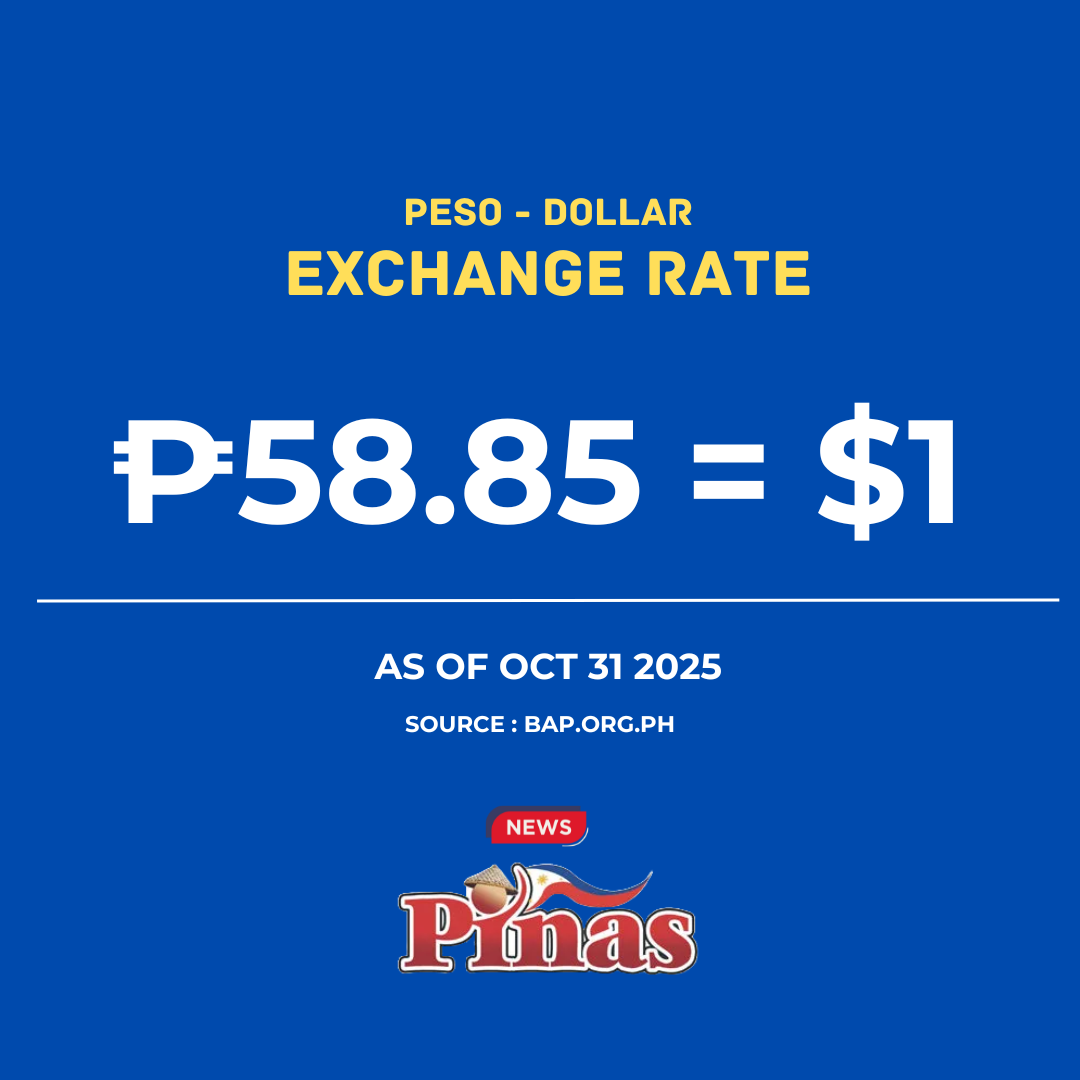
As of October 31, the US dollar (USD) traded at ₱58.72, slightly stronger by 0.14 centavos, but down 0.24% for the day. This shows the peso’s quiet resilience even as global markets react to shifting interest rates and oil price changes.
Meanwhile, the euro (EUR) slid to ₱67.85, marking a 0.33% drop. The British pound (GBP) followed with a sharper dip of 0.53%, settling at ₱76.99 — a sign that European currencies are feeling pressure from slower growth and market uncertainty.
From the Pacific side, the Australian dollar (AUD) slipped 0.49% to ₱38.39, while the New Zealand dollar (NZD) weakened even more, falling 0.71% to ₱33.58. These moves suggest that commodity-linked currencies are taking a hit as global demand cools.
Over in Asia, the Japanese yen (JPY) slightly strengthened to ₱2.61, though the change was minimal — a quiet performance in a week dominated by safe-haven plays. The Chinese yuan (CNY), on the other hand, edged up 0.41%, showing slight recovery amid mixed economic data from Beijing.
Some lesser-followed but interesting currencies also made moves:
-
The Swiss franc (CHF) and Canadian dollar (CAD) both inched higher by 0.46% and 0.49% respectively, signaling modest confidence in the North American bloc.
-
The Mexican peso (MXN) gained 0.44%, while the Indian rupee (INR) slipped slightly by 0.11%.
-
The Brazilian real (BRL) held steady, but still shows an 8% drop for the year — one of the biggest declines among emerging markets.
A dramatic fall came from the Russian ruble (RUB), plunging 0.97% for the day and a massive 19.19% year-to-date. Geopolitical tensions and sanctions continue to weigh heavily on its value.
Across Asia, other regional players showed modest movement:
-
The South Korean won (KRW) barely moved, staying around ₱24.31.
-
The Indonesian rupiah (IDR) edged up 0.12%, showing steady performance.
-
The Argentine peso (ARS) remains the most volatile — down 0.39% today but up 43.61% year-to-date, reflecting the country’s ongoing inflation battle.
Meanwhile, the Czech koruna (CZK), Danish krone (DKK), and Hungarian forint (HUF) all posted minor declines, echoing Europe’s overall currency weakness.
In short, the Philippine peso stood firm amid a mixed global currency landscape — slightly losing against some, gaining against others, but overall maintaining stability.
As global investors watch for central bank decisions and inflation data in November, the peso’s next moves will depend on how the world’s biggest economies navigate their own storms.