
THE HAGUE, Netherlands — Emotions ran high on the third day of the confirmation of charges hearing before the International Criminal Court.
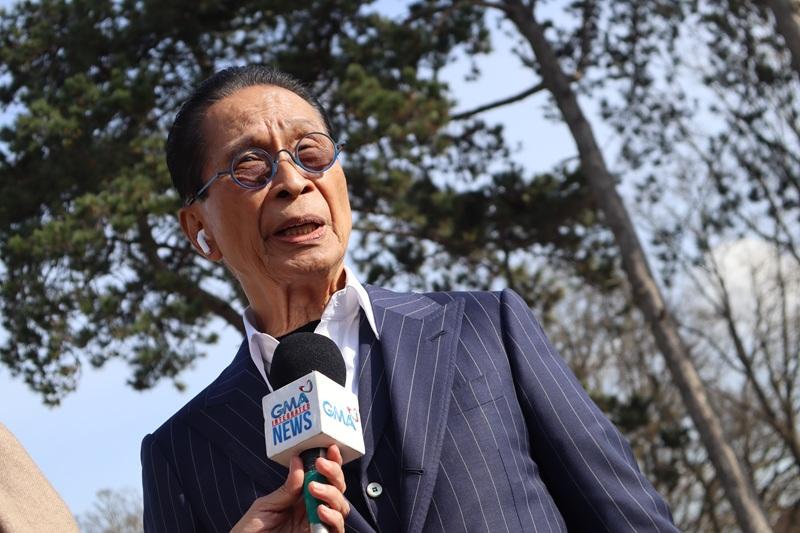
Outside the courtroom, Salvador Panelo did not hold back.
The former presidential spokesperson and legal counsel for Rodrigo Duterte declared that the prosecution’s case had been “shattered to pieces.”
His words were sharp. Certain. Final.
“The prosecution theory has been shattered to pieces,” Panelo told reporters.
He insisted that both testimonial and documentary evidence presented against the former president failed to establish liability for alleged crimes against humanity tied to the controversial war on drugs.
According to Panelo, what was meant to be a strong case crumbled under scrutiny.
He described the witnesses’ statements as weak — built, he claimed, on hearsay, double hearsay, speculation, and surmises. Worse, he alleged contradictions not only between different witnesses but even within their own testimonies.
For the defense camp, that was fatal.
“You can win a case on the basis of testimonial and documentary evidence,” Panelo said. “Pag nasira ka doon, kalimutan mo na yung kaso mo. Tanggapin mo na yung pagkatalo mo.”
If your evidence collapses, he argued, your case collapses with it.
A Document That ‘Backfired’
Panelo also zeroed in on a police circular presented by prosecutors — a document they claimed showed a command to kill and coordination between Duterte and law enforcement.
But Panelo said the document did the opposite.
He pointed out that the circular explicitly required arrests to be carried out “in accordance with the law.”
For him, that line changed everything.
“Kaya sumabog sa mukha nila lahat,” he said — suggesting the evidence backfired on the prosecution itself.
He dismissed prosecutors’ confidence in their presentation.
“They are entitled to their imagined satisfaction,” Panelo remarked bluntly. “In short, bagsak sila.”
If the judges rule purely on evidence, he added, the case should be dismissed.
The Prosecution’s Stand
Inside the courtroom, however, a very different picture was painted.
ICC Prosecutor Mame Mandiaye Niang argued that Duterte played a central role in what he described as a common plan to “neutralize alleged criminals” — including through murder.
“His contribution was essential,” Niang said, placing Duterte “at the very heart” of the alleged crimes.
The ICC Office of the Prosecutor has charged Duterte with three counts of crimes against humanity — murder and attempted murder — in connection with his anti-narcotics campaign.
Duterte himself was not present at the hearing.
The Jurisdiction Question
Beyond the evidence, Panelo revived a familiar argument: the ICC should not even be hearing the case.
He cited the Rome Statute’s principle of complementarity — which holds that the ICC steps in only when national courts are unwilling or unable to prosecute.
“This court has assumed jurisdiction when there is none,” Panelo said.
For the defense, the issue of jurisdiction remains a critical fault line — one they believe undermines the entire proceeding.
Hope — And Caution
Despite his confident tone, Panelo acknowledged uncertainty.
“We are hoping for the best and expecting the worst,” he admitted.
It was a rare moment of restraint amid fiery remarks.
The stakes are enormous. The courtroom is thousands of miles away from the Philippines — but the political and legal impact is deeply felt back home.
Praise for the Defense
Panelo also lauded lead defense counsel Nicholas Kaufman, describing him as meticulous and relentless in preparation.
“He made a thorough research. He read all the speeches. He went over all the documents,” Panelo said.
According to him, Kaufman dismantled the prosecution’s claims point by point.
Though Panelo described himself and other Duterte allies as mere observers, he hinted they may have contributed insights along the way.
“Siguro nakatulong din kami,” he said with a faint smile. “May napulot siya sa amin.”
For now, the arguments have been laid bare.
Two sharply opposing narratives stand before the judges — one claiming a systematic campaign of violence, the other insisting the case has already fallen apart.
The decision will rest not on emotion, nor on rhetoric — but on evidence.
And both sides believe it is on their side.