
The National Disaster Risk Reduction and Management Council (NDRRMC) has raised its Operations Center to Red Alert—the highest level of emergency response—following the series of strong earthquakes that rocked Manay, Davao Oriental.
In a statement released Sunday, the NDRRMC confirmed that response clusters were activated at noon on Friday, October 10, to immediately mobilize agencies responsible for rescue, relief, and recovery.
Government on Full Emergency Mode
Under the red alert status, the Office of Civil Defense (OCD) is taking charge of logistics and early recovery operations. Meanwhile, the Department of Social Welfare and Development (DSWD) is leading efforts to provide food, non-food items, camp management, and protection for displaced families.
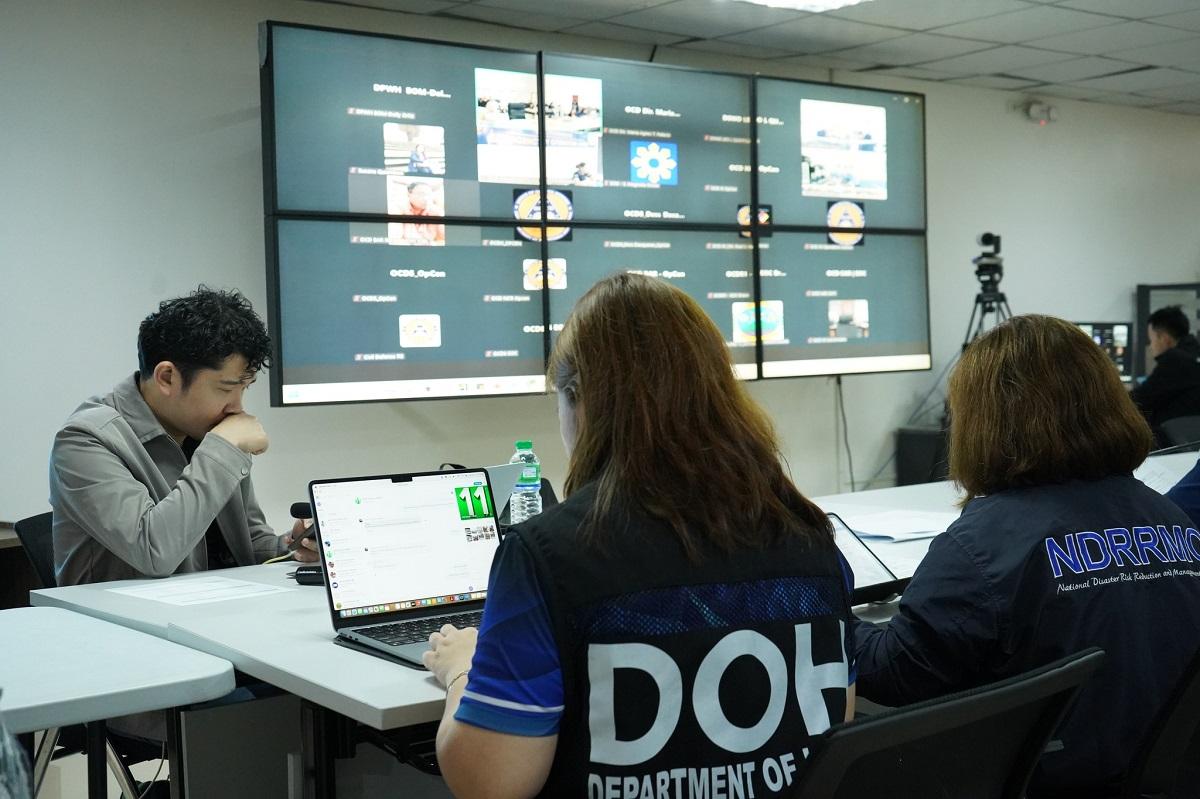
“The highest alert level means that teams from the AFP, PNP, Bureau of Fire Protection (BFP), and the Philippine Coast Guard (PCG), as well as technical personnel from the DILG, DSWD, DPWH, and DOH, must be on duty at the Operations Center in Camp Aguinaldo,” the OCD explained.
Other concerned agencies also joined emergency operations through virtual coordination platforms to ensure swift communication and response.
Agencies Take On Critical Roles
Each department has been assigned clear responsibilities:
-
AFP: Search, rescue, and retrieval operations
-
DOH: Medical and health response
-
PNP: Law and order
-
PIA: Crisis communications
-
DICT: Emergency telecommunications
-
DPWH: Clearing of debris and civil works
-
DHSUD: Shelter and housing
-
DFA: Standby for international humanitarian coordination
-
OCD: Overall early recovery operations
President Marcos Orders Immediate Evacuations
President Ferdinand “Bongbong” Marcos Jr. directed the NDRRMC, OCD, Armed Forces, Coast Guard, and all concerned agencies to carry out evacuations in coastal areas, activate emergency communication lines, and coordinate closely with local governments.
“Our priority is the safety of everyone. All agencies must move fast and work together,” the President said.
Teodoro Orders Review of Earthquake Plans
Defense Secretary Gilberto Teodoro Jr. has instructed all local government units (LGUs) to enhance earthquake preparedness and review their contingency plans, especially after recent strong tremors in Cebu and Davao.
He emphasized that even areas not directly hit should hold large-scale earthquake drills, particularly in schools, government offices, and public facilities.
“Sa mga areas na hindi nalindol, please tell the LGUs na mag-review o mag-practice ng earthquake drill protocols,” Teodoro urged.
Series of Earthquakes Rattle the Country
The Davao Oriental quake, a magnitude 7.4 tremor that struck offshore Manay on Friday morning, was followed by another magnitude 6.8 earthquake in the evening.
Other parts of the country also felt the earth’s fury:
-
October 9: Magnitude 4.4 quake in Pugo, La Union
-
October 11: Magnitude 6.0 quake near Cagwait, Surigao del Sur
-
October 1: Bogo, Cebu experienced its strongest quake on record
Impact and Damage
As of October 12, 2025, data from the OCD shows that the earthquakes have affected 125,283 families—around 491,258 individuals—across Davao Region and Caraga. There have been eight reported deaths and 395 injuries, with total estimated damages reaching ₱100 million.
Due to ongoing assessments, some areas in Mindanao have suspended classes for Monday, October 13, to ensure safety while evaluations continue.
The NDRRMC assured the public that response teams remain on full alert, working round the clock to deliver aid, restore order, and bring hope to families shaken by the recent disasters.
“We are all hands on deck,” the agency said. “Together, we will rebuild and recover.”