There are moments in the news that feel heavy—even before the full story is told.
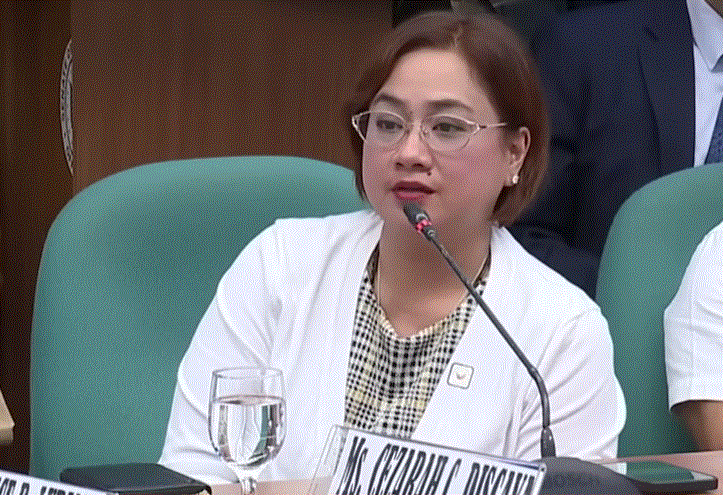
On Tuesday morning, contractor Sarah Discaya walked into the National Bureau of Investigation (NBI) headquarters in Pasay City and surrendered.
No chase. No dramatic arrest.
Just a decision—and a request.
NBI Acting Director Lito Magno confirmed it Wednesday, saying Discaya appeared early and asked to be placed under the NBI’s authority right away.
“She appeared in the morning and asked to be placed under our jurisdiction without delay,” Magno said.
It’s the kind of line that makes people pause.
Because when someone asks for custody “without delay,” it doesn’t sound casual. It sounds urgent. It sounds like someone stepping into the storm before it arrives.
“A Legal Strategy,” Her Lawyer Says
Discaya’s camp was quick to frame the move as calculated—not confessional.
Her legal counsel, Atty. Cornelio Samaniego III, said the surrender was a “strategic legal move” and not an admission of wrongdoing.
In simple terms: She’s cooperating—but she’s not saying she’s guilty.
That distinction matters, especially with the accusations now surrounding her name.
The Case: A P96.5-Million “Ghost” Project
At the heart of the issue is a flood control project—one that, according to the Ombudsman, may have been a ghost project worth P96.5 million in Davao Occidental.
Because of this, the Office of the Ombudsman filed malversation and corruption charges against Discaya and others.
It’s a serious claim, and it hits a sensitive nerve: money meant to protect communities from flooding—money that should have meant safety.
Instead, it may now become a courtroom battle.
Where the Complaints Were Filed—and Why It Matters
Supreme Court spokesperson Atty. Camille Ting explained that two complaints were filed with the Regional Trial Court (RTC) in Malita, Davao Occidental.
But here’s where it gets procedural.
The documents were received by the Digos RTC first (since they share the same office), then immediately transmitted to RTC Malita.
And now, the cases are waiting to be moved again—this time to a special anti-graft court in the nearest region.
In short: the legal machine is turning, step by step, paper by paper—until the cases land in the right courtroom.
Not Just One Surrender: Eight More Officials Step Forward
Discaya isn’t the only name in the spotlight.
Magno also revealed that eight Public Works and Highways officials linked to the Culaman Flood Control case voluntarily surrendered as well—this time at NBI SEMRO XI on December 7.
They signed letters of voluntary surrender and placed themselves under NBI custody.
Magno said their move showed intent to face the process head-on.
“All eight officials executed letters of voluntary surrender and placed themselves under NBI custody, affirming their intent to face the legal process,” he said.
What Happens Next
For now, the story isn’t about a verdict—it’s about a turning point.
A surrender.
A legal strategy.
A case involving public funds and public trust.
And a question that hangs in the air, quietly but powerfully:
When the dust settles, what will the courts find—a misunderstanding… or a betrayal?