
For many Filipinos, love has always been a source of strength.
A comfort.
A reason to smile after a long day.
A light in uncertain times.
But the latest Social Weather Survey (SWS) suggests that light may be dimming.
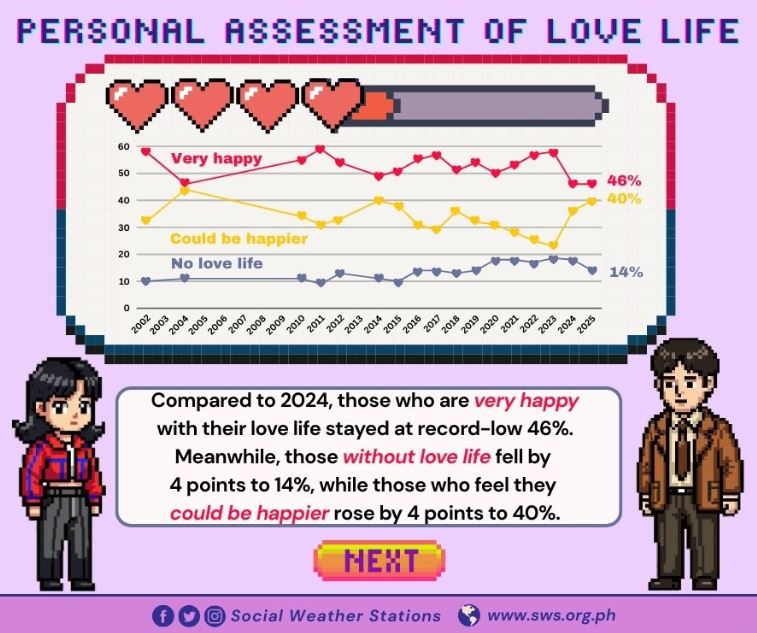
Only 46% of adult Filipinos now say they are “very happy” with their love life — the lowest level recorded in over 20 years.
The number hasn’t changed from last year.
And that’s the troubling part.
Because it remains at a record low.
What the Numbers Say
The nationwide survey, conducted from November 24 to 30, 2025, interviewed 1,200 adults face-to-face across Metro Manila, Luzon, the Visayas, and Mindanao.
Here’s what Filipinos shared:
• 46% say they are very happy with their love life
• 40% say they could be happier
• 14% say they have no love life at all
Those who feel they “could be happier” increased by four points from last year.
Meanwhile, those with no love life dropped slightly — from 18% to 14%.
So fewer people are alone.
But more people feel something is missing.
And that speaks volumes.
Married Couples Still Lead — But There’s a Shift
Among women, happiness remains highest among those who are married.
• 57% of married women say they are very happy
• 45% of women with live-in partners
• 22% of women with no spouse or partner
There’s a small bright spot: married women saw a slight three-point increase in happiness.
But for women in live-in relationships, happiness fell sharply — down eight points.
Among single women, it slipped slightly as well.
Among men, the story is similar — but with sharper contrasts.
• 55% of married men are very happy
• 50% of men with live-in partners
• 28% of men with no spouse or partner
Interestingly, happiness among single men jumped significantly — up nine points from last year.
But married men saw a six-point drop.
Even within stable relationships, something seems to be shifting.
A Nation Divided Between Contentment and “Could Be Happier”
The phrase “could be happier” may be the most revealing part of the survey.
Forty percent of Filipinos chose it.
Not unhappy.
But not fully happy either.
It suggests longing.
Expectation.
Perhaps pressure from financial stress, work demands, distance, or modern dating realities.
Love may still be present.
But for many, it doesn’t feel complete.
Who Took the Survey?
The respondents were evenly split:
• 50% urban, 50% rural
• Equal number of men and women
• 33% aged 55 and above
• Only 11% youth aged 18-24
The survey had a ±3% margin of error nationwide and was non-commissioned.
What Does This Really Mean?
Love in the Philippines has always been romanticized.
Grand gestures.
Endless patience.
Deep emotional bonds.
But today’s numbers suggest a quieter truth.
Many Filipinos are staying in relationships.
But fewer are saying they feel “very happy.”
Is it economic pressure?
Emotional exhaustion?
Changing expectations?
Perhaps all of the above.
One thing is clear:
Love is still alive in the Philippines.
But for many, it’s no longer at its brightest.
And that, more than any statistic, is what makes this record low feel heavier than ever.