

(UPDATE) SEN. Panfilo Lacson on Monday declared that Congress itself was the “original sin” behind the multi-billion-peso flood control corruption scandal, blaming budget insertions for creating conditions that allowed anomalous projects and kickbacks to flourish.
“If there were no insertions, corrupt officials would have nothing to exploit,” said Lacson, who is leading the Senate Blue Ribbon Committee investigation into anomalous flood control projects under the Department of Public Works and Highways (DPWH).
Lacson’s assessment came as the Independent Commission for Infrastructure (ICI), created by President Ferdinand Marcos Jr. to investigate government public works projects over the last decade, warned that it had received reports that DPWH personnel had destroyed and tampered with official records.
ICI chairman retired Justice Andres Reyes Jr. said the alleged destruction of records not only obstructs ongoing investigations but also undermines the public’s trust in government institutions tasked to safeguard public resources.
“Any attempt to destroy, falsify, or conceal them is a grave offense that carries both administrative and criminal liability,” Reyes said in a statement.
He stressed that all records relating to public works are government property and must be preserved intact.
Lacson said the destruction of records was illegal.
“That’s criminal… You’re destroying the records so that your shenanigans can’t be traced,” he said in English and Filipino.
Room for abuse
In an interview, Lacson said that while amendments to the budget are not illegal, they enabled questionable allocations that later became vulnerable to abuse once in the hands of district engineering offices of the DPWH.
The senator said this dynamic was evident in the testimony of whistleblower Brice Hernandez, who provided sealed documents and computer files said to detail transactions involving flood control projects.
Hernandez’s revelations matched actual appropriations: P675 million tied to Sen. Joel Villanueva, broken down into eight projects, and P355 million linked to Sen. Jinggoy Estrada in seven projects.
Both senators have denied wrongdoing, and Lacson stressed that insertions are not unlawful per se.
“What is against the law is the giving and receiving of kickbacks,” he said.
Chain of custody, CIDG ‘glitch’
The Senate is now safeguarding Hernandez’s files under strict chain-of-custody rules, anticipating their potential evidentiary value.
Forensic analysis will be turned over to the National Bureau of Investigation (NBI) and the Philippine National Police (PNP).
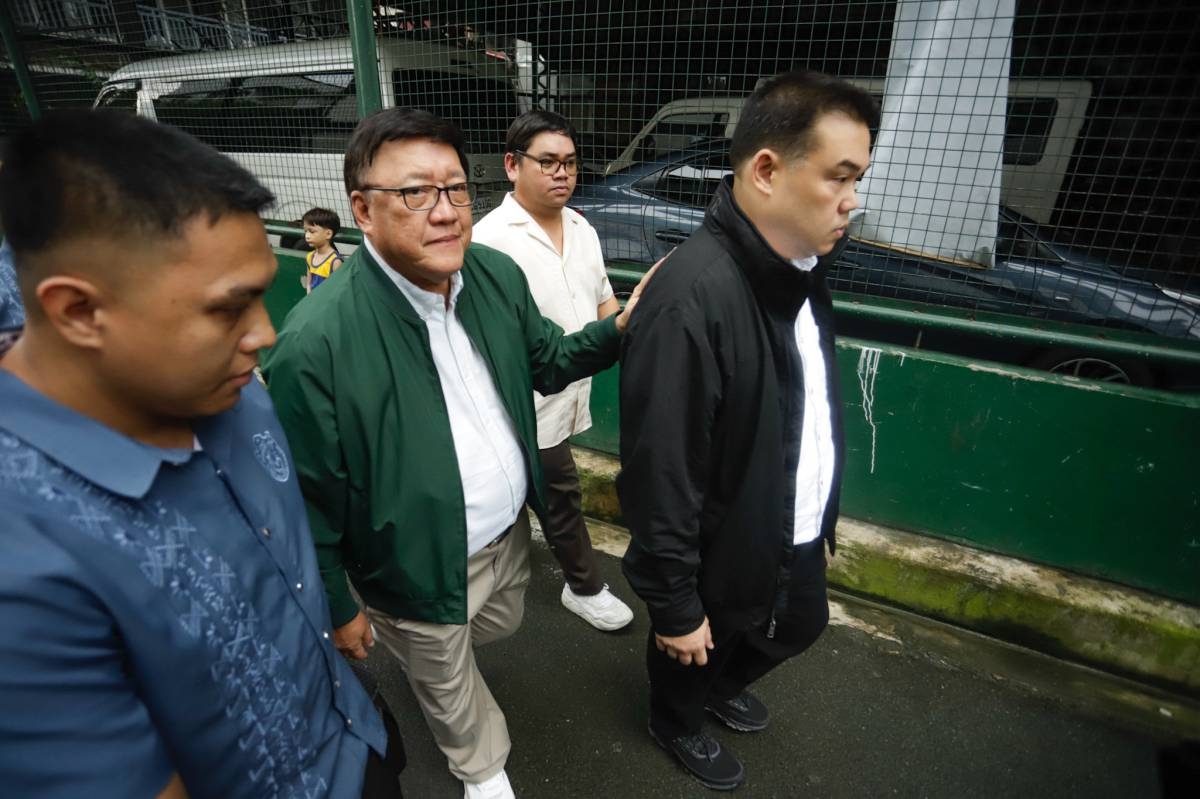
The matter of custody took a complicated turn last week after Senate President Vicente Sotto III authorized Hernandez to return to his residence on Saturday to retrieve possible hard evidence, including laptops and documents, that he had earlier refused to hand over.
Senate security officials, led by retired police general Mao Aplasca of the Office of the Sergeant-at-Arms, accompanied Hernandez to ensure proper documentation and sealing of the materials.
But the operation was disrupted when Criminal Investigation and Detection Group (CIDG) agents arrived at the site without prior coordination with the Senate. Their sudden presence caused Hernandez to hesitate in turning over his computer, prompting Senate security to seal the devices on the spot.
“We need to clarify why CIDG agents were there, because this was an operation under the Senate,” Lacson said, noting that the Senate will seek an explanation.
Photos taken during the retrieval showed Hernandez himself signing off on the sealing of the evidence.
According to Lacson, this was done to protect the integrity of the files until proper forensic protocols can be applied.
“Once these are unsealed and examined, we will know whether they corroborate the allegations of kickbacks,” he said.
Standard of proof
Lacson emphasized that allegations will remain insufficient until supported by documents, ledgers, or digital notes that establish bribery or kickbacks.
“We are bound by evidence. Allegations remain allegations until backed by credible proof,” he said.
Such material, once validated, could form the basis of cases before the Ombudsman or the Department of Justice.
He cited the testimony of witness Sally Santos, who detailed cash deliveries amounting to P457 million in March, P155 million in April, and P41 million in May. These figures were later confirmed by Hernandez, strengthening their credibility.
“This is the kind of testimony we need — allegations backed by receipts and corroboration,” Lacson said.
Senators’ role questioned
Public pressure has mounted for Estrada and Villanueva to inhibit themselves from the hearings, but Lacson insisted this cannot be imposed.
“Inhibition is a personal decision. They also have the right to confront their accuser,” he said, adding that even judges are given discretion by the Supreme Court in similar cases.
Some critics have argued that senators accused in the controversy should not sit in judgment of witnesses testifying against them, but Lacson maintained that due process must prevail.
“It would be unfair to brand them guilty without sufficient evidence,” he said.
Complementing ICI’s probe
Lacson said the Senate investigation does not intend to compete with the newly created ICI, but to complement its efforts.
“We don’t intend to wait for a committee report before turning over evidence. Anything with evidentiary value will be sent immediately to the ICI,” he said.
He also noted that the Senate’s contempt and detention powers provide leverage in eliciting cooperation from reluctant witnesses.
“Sometimes a night in detention makes people reflect and decide to tell the truth,” Lacson said.
He pointed to Hernandez and Santos, who only began revealing details after being placed in Senate custody.
Next steps
The Blue Ribbon Committee is expected to reopen Hernandez’s files once the proper forensic protocols are in place and to continue calling witnesses in the weeks ahead.
Lacson emphasized that the hearings aim to trace accountability “back to the roots,” meaning congressional insertions that enabled the flood control scam.
The probe was triggered by President Ferdinand Marcos Jr.’s State of the Nation Address, where he revealed widespread anomalies in flood control projects.
Since then, witnesses have described large-scale cash deliveries to district offices and contractors, pointing to what Lacson called a network of corruption.
“The important thing is to get to the bottom of this and let the truth come out,” Lacson said.
The Senate Blue Ribbon Committee is scheduled to reopen its investigation into the flood control corruption scandal on Tuesday, Sept. 24, 2025.
Meeting with ICI
On Monday, Senate President Vicente Sotto III met with members of the ICI to shed light on how the Senate handles budget amendments and insertions — procedures that have figured prominently in testimonies on alleged irregularities tied to flood control projects.
Sotto said the ICI sought clarification on the mechanics of budget realignments, including the distinction between institutional amendments, individual amendments, and last-minute insertions.
He warned, however, that changes introduced after the budget had passed third reading, particularly during bicameral conference committee (Bicam) deliberations, fall into the category of “illegal insertions.”
“The worst of all is when there are insertions made during the bicam. After the third reading is done, and then you insert something at the bicam — that’s an illegal insertion,” he said after the meeting.
The Senate leader disclosed that the commission specifically asked for minutes of the so-called “small committee,” a four-member panel accused of introducing questionable insertions in the 2025 national budget.
The group was reportedly composed of former House Committee on Appropriations chairman Elizaldy Co, former Senate president Francis Escudero, former House speaker Martin Romualdez, and former senator Grace Poe.
Sotto explained that while small committees are often formed to streamline bicam discussions, all their recommendations must still undergo approval by the full bicameral conference.
“What comes out of the small bicam must be approved by the regular bicam and should be clear and transparent,” he said.
The ICI was established following revelations by former district engineer Brice Hernandez, who turned over boxes of documents and computer files allegedly showing how lawmakers and contractors manipulated allocations through budget insertions for flood mitigation programs.
The commission is set to open its first hearing this week. Ahead of that proceeding, Sotto also held consultations with Lacson and Justice Secretary Jesus Crispin Remulla to coordinate ongoing investigations into the alleged multi-billion-peso scam.
Both Sotto and Lacson earlier emphasized the need to probe anomalies in the budget process, particularly in the flood control program that has been plagued by ghost projects and fund diversions.
Sotto assured the public that the Senate remains committed to working with oversight bodies to strengthen transparency.
He vowed reforms in future deliberations, including measures for greater public access to budget discussions.
“For the 2026 budget, to prevent that from happening again, we will make sure that if ever there is a necessity for a smaller bicam, we will still make it open to the public — through livestreaming,” he said.
Nueva Ecija probe
Meanwhile, a P48.114 million flood control project in San Fernando, Bambang, Nueva Ecija, is now the subject of ongoing investigation by the ICI for alleged overpricing and conflict of interest.
Based on the evaluation and observation report submitted to the ICI, the DPWH-First District Engineering Office of Nueva Vizcaya, headed by District Engineer Marifel T. Andes, awarded the P48,114,504.55 flood control project to Citrus Country Construction (CCC) for the construction of a 300-meter slope protection.
According to the report, the 300-meter slope protection project was awarded at a cost of P155,157.28 per linear meter, which investigators were questioning as too high. There were also concerns about a vague clause in the contract, which could allow for additional, unapproved payments to the contractor.
The investigation is looking into the alleged involvement of Maria Teresa Perlita V. Gambito, wife of Nueva Vizcaya Gov. Jose Gambito, in her capacity as the authorized managing officer of CCC, raising suspicions of conflict of interest.
Under Republic Act (RA) 3019 or the Anti-Graft and Corrupt Practices Act, and RA 6713, the Code of Conduct and Ethical Standards for Public Officials and Employees, public officials and their families are prohibited from engaging in contracts that could personally benefit them.