

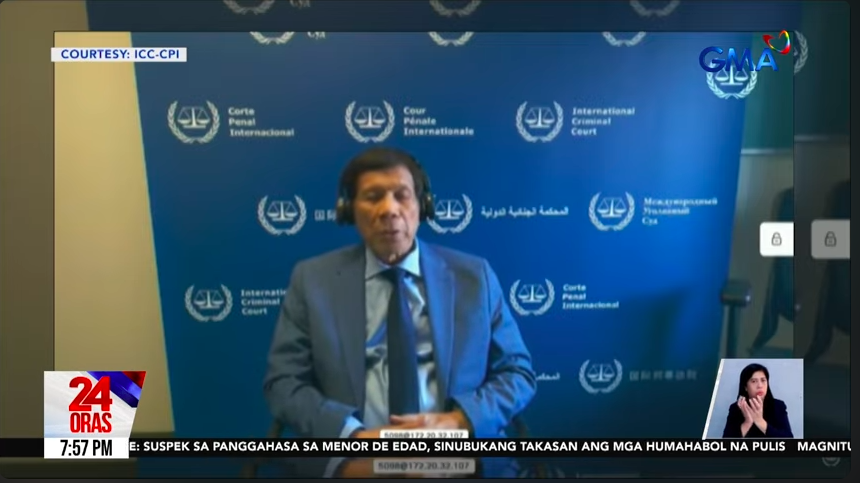
The fight for justice at the International Criminal Court (ICC) took a sharp turn this week, as the Office of the Public Counsel for Victims (OPCV) firmly rejected former President Rodrigo Duterte’s request to indefinitely halt proceedings against him.
In a 14-page filing dated October 8, OPCV Principal Counsel Paolina Massidda said Duterte’s bid for an indefinite suspension of his case was “unjustified.” She stressed that the arguments raised by his defense “do not suffice to warrant it.”
But while the OPCV stood its ground against stopping the case, it also acknowledged concerns about Duterte’s health. The 80-year-old former president’s legal team has repeatedly claimed he is suffering from cognitive deterioration, affecting his memory and ability to participate in trial.
Massidda urged the ICC to appoint independent medical experts to thoroughly examine Duterte’s condition. “This is not only for the suspect’s own benefit,” she explained, “but also to ensure that the ICC can make a fair assessment of his ability to stand trial.”
The OPCV emphasized that justice cannot simply be paused. “Victims, the defendant, and the international community all have a vested interest in seeing proceedings progress where possible,” the filing said.
For families of extrajudicial killing victims linked to Duterte’s bloody war on drugs, the words carried deep weight. The OPCV reminded the court: “The interests of justice require that those suspected of committing the gravest crimes be tried fairly and without unnecessary delay. Victims of atrocity crimes are also entitled to truth and accountability.”
Still, the OPCV did not entirely close the door on the defense’s alternative suggestion—holding a status conference to discuss scheduling and available options.
Duterte, arrested in March and detained in The Hague, was originally set to appear before the ICC on September 23 for the confirmation of charges hearing. But the session was suspended after his lawyer, Nicholas Kaufman, claimed Duterte was unfit to proceed.
Kaufman alleged that the former president could no longer recall important details—dates, events, even family members—because of worsening cognitive decline.
Yet just weeks before that, Vice President Sara Duterte had painted a very different picture. She shared that she recently spoke with her father over the phone about politics, flood control controversies, and even his love life—assuring the public that her father was “okay.”
Now, with the victims’ counsel opposing Duterte’s attempt to indefinitely delay justice, the question lingers: Is the former president truly too ill to face trial—or is this just another attempt to escape accountability?