


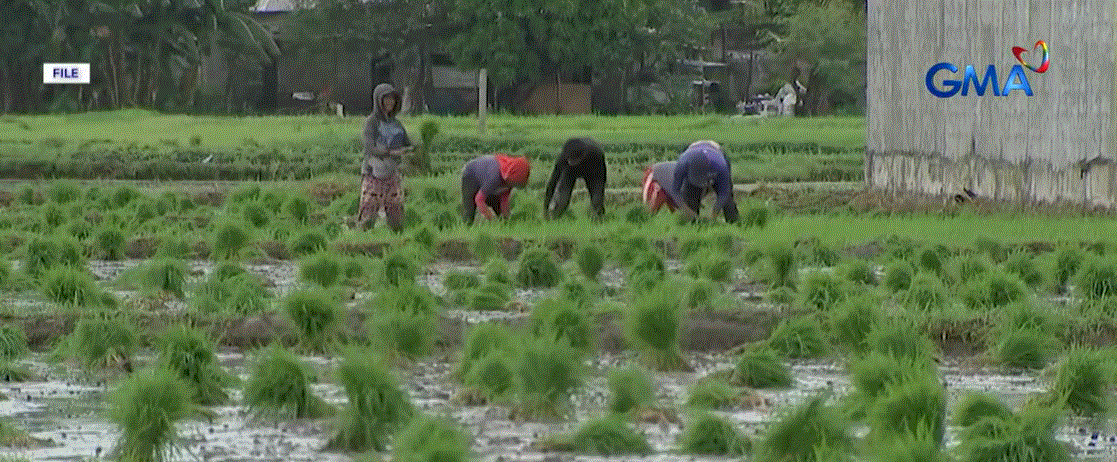
Despite an import ban and a string of powerful storms, the country’s rice supply — and its prices — remain steady.
That was the assurance from the Department of Agriculture (DA) on Saturday, offering much-needed relief to consumers and farmers alike.
“Even with the import ban, our rice supply is good,” said Assistant Secretary Arnel de Mesa, DA spokesperson, in an interview on Dobol B TV.
“And despite the typhoons, we expect a strong harvest until the end of the year.”
He explained that the outlook remains positive. A good harvest is expected to carry through the year, with another harvest season already in sight by March to April. Add to that the reopening of rice importation by January, and both supply and prices are expected to become even more stable.
De Mesa said there is even a chance the country could surpass its 2023 record rice harvest — which reached 20.06 million metric tons.
“There’s a possibility we beat the 2023 record,” he said.
“But we still need to wait for the official data.”
He noted that while storms also hit the country in 2023, they were far less destructive than what followed.
In 2024, the Philippines endured an intense El Niño, followed by a strong La Niña that brought more frequent and powerful typhoons. As a result, rice production dropped by around one million metric tons, forcing the country to increase importation last year.
Still, the situation today is far from alarming.
According to the DA, the country’s closing rice inventory is expected to last between 80 to 85 days at the low end — and over 100 days at the high end. Daily rice consumption stands at roughly 37,000 metric tons.
Importation resumes in January
De Mesa confirmed that rice importation will reopen in January, with volumes carefully adjusted based on updated data — and only until the next local harvest arrives in March or April.
“By mid-November, imported rice had almost completely disappeared from the market,” he said, noting that only locally produced rice is currently being sold following the import ban that took effect in September.
Prices, he added, remain stable.
Premium imported rice, if still available, sells for around ₱50 per kilo, while specialty varieties like jasmine and Japanese rice may reach ₱60 per kilo. Locally produced premium rice also retails at about ₱50 per kilo.
Ideally, imported rice should be cheaper, de Mesa said — but prices still depend on costs from source countries, much like the situation with onions.
To protect local farmers, the government will closely monitor rice imports each month, ensuring the country does not bring in more than what is needed.
In the past, import volumes spiked to 550,000 metric tons in a single month, far above the ideal average of 300,000 MT. Such surges, de Mesa warned, can push farmgate prices down — especially when harvest season is near.
Helping farmers get fair prices
Current farmgate prices of palay range from ₱17 to ₱18 per kilo, but some traders still take advantage of farmers, particularly in remote areas.
To address this, DA Secretary Francisco “Kiko” Tiu Laurel has proposed redirecting fertilizer funds to the National Food Authority (NFA) so it can buy more palay directly from farmers.
“If the NFA can buy even up to 20% of total harvest, it would make a huge difference,” de Mesa said.
“At present, it can only accommodate about 5%.”
For farmers, better prices matter more than anything else. And for consumers, the message is clear — rice remains available, prices are steady, and supply is secure for the months ahead.