

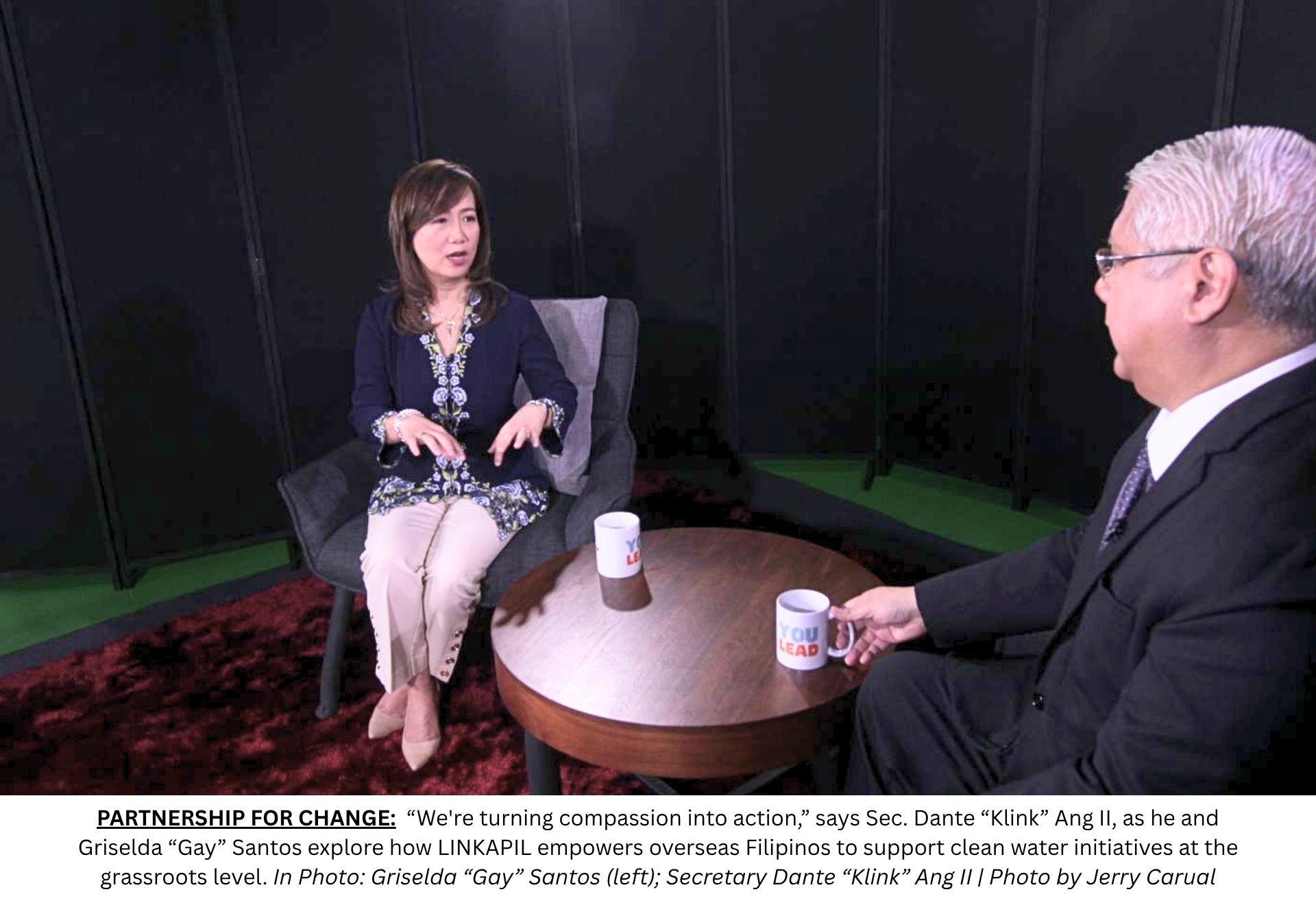
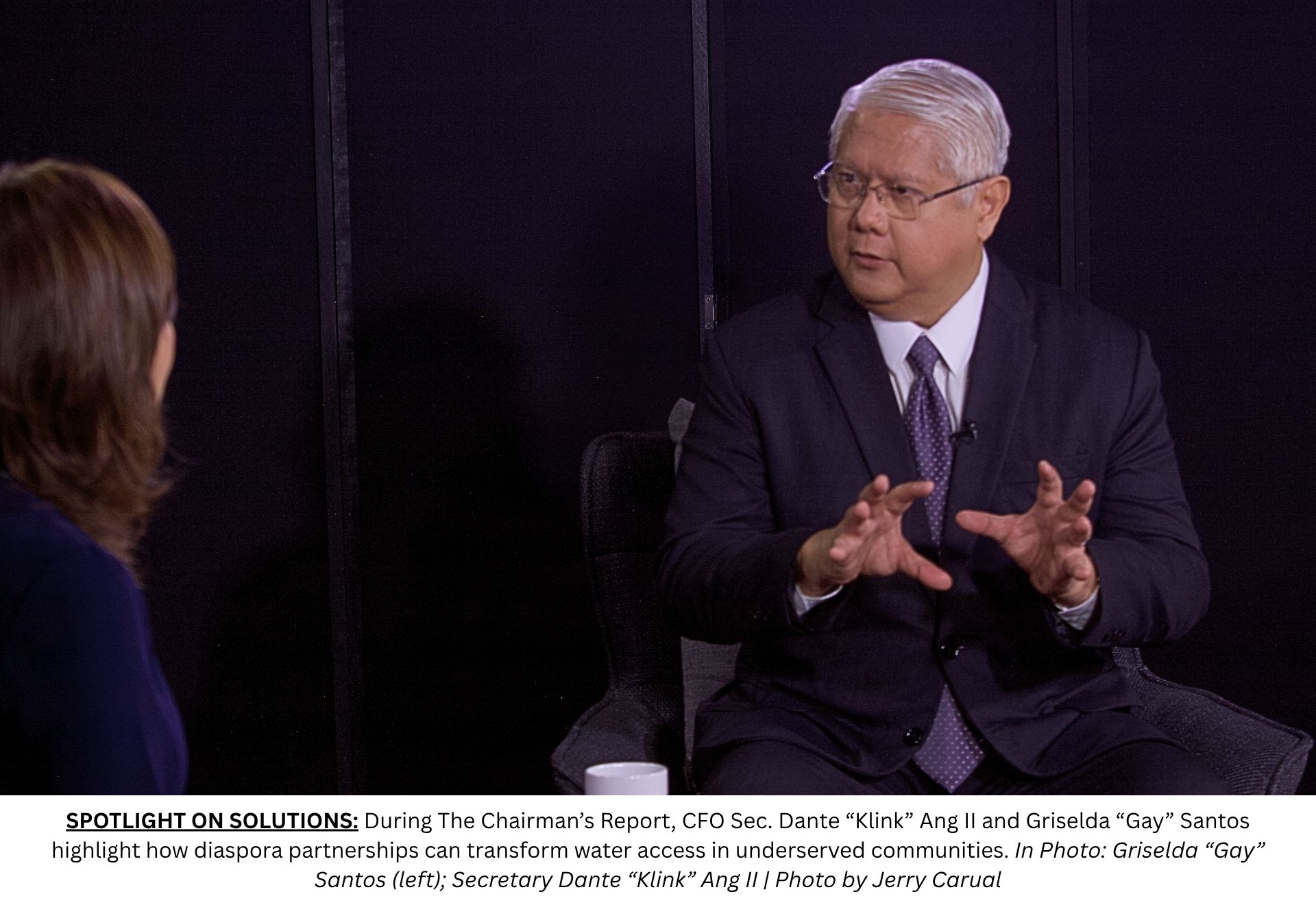
Water.org is calling for more partners across the Philippines to help accelerate access to safe water and sanitation in rural communities, especially in areas where conventional infrastructure solutions have failed to reach, Griselda “Gay” Santos, the organization’s Regional Director for Southeast Asia, said during a recent episode of The Chairman’s Report, hosted by Commission on Filipinos Overseas (CFO) Secretary Dante “Klink” Ang II.
Strengthening this drive, the organization has partnered with the CFO to mobilize the global Filipino diaspora as a force for sustainable change.
“The Philippines is an archipelago. Solutions can’t be one-size-fits-all. In many rural areas—especially in CALABARZON, Visayas, and Bangsamoro—waterborne diseases are still very high,” Santos said.
In partnership with CFO’s Lingkod sa Kapwa Pilipino (LINKAPIL) program, Water.org aims to scale its impact by connecting with more local financial institutions and grassroots organizations that can bring their proven water access models to underserved areas.
Ang said, “This partnership demonstrates how strategic collaboration with the global Filipino community can help solve urgent local problems. Through LINKAPIL, we are turning compassion into action—empowering communities with tools, not just aid.”
Santos emphasized that partnerships—not just clients—are key to making water and sanitation loans accessible to Filipinos. “That’s why we are partnering with the CFO. Our partners are the networks of financial institutions. We try to enlighten and establish their understanding of the need for a loan product dedicated to water and sanitation,” she explained.
At the heart of Water.org’s strategy is the WaterCredit Initiative®, a microfinance model that allows low-income families to access small, affordable loans to install water taps and toilets at home. Already reaching over 79 million people globally, the initiative leverages a sustainable, pay-it-forward system that reduces dependency on aid while scaling up impact. Since 2014, 11 million Filipinos benefited from this approach, highlighting the effectiveness in addressing the water and sanitation crisis in vulnerable communities.
Formalized in May 2025, the CFO-Water.org collaboration introduces WaterCredit to Filipino households through LINKAPIL’s development networks. This approach ensures that solutions are not only locally driven, but also long-term and community-owned.
The CFO’s LINKAPIL program serves as a bridge between overseas Filipinos and local civil society organizations, enabling direct investment in impactful projects. With this partnership, overseas Filipinos can help fund clean water access while tracking contributions transparently—aligning global support with local needs.
Water.org’s broader mission involves partnering with more stakeholders in the Philippines to replicate successful models nationwide.
This effort comes at a time when over 60 million Filipinos still lack access to safe drinking water, and 45 million are without proper sanitation, according to Water.org data. Factors such as climate change, extreme weather, and the Philippines’ archipelagic geography continue to hinder centralized infrastructure, underscoring the need for adaptable, decentralized solutions.
The initiative also supports President Ferdinand “Bongbong” Marcos Jr.’s Bagong Pilipinas vision for inclusive and resilient development. By focusing on health, sanitation, and grassroots empowerment, the CFO reinforces its role in building a healthier Philippines through diaspora partnerships.
𝐀𝐛𝐨𝐮𝐭 𝐭𝐡𝐞 𝐂𝐨𝐦𝐦𝐢𝐬𝐬𝐢𝐨𝐧 𝐨𝐧 𝐅𝐢𝐥𝐢𝐩𝐢𝐧𝐨𝐬 𝐎𝐯𝐞𝐫𝐬𝐞𝐚𝐬
The CFO, established under Batas Pambansa Blg. 79, is dedicated to the welfare and empowerment of Filipinos permanently residing abroad. It is distinct from the Department of Migrant Workers (DMW), which primarily addresses the needs of Overseas Filipino Workers (OFWs), and other temporary migrants.
CFO works to strengthen the social, economic, and cultural ties of global Filipinos with their home country. Its primary constituents include Filipino permanent migrants, dual citizens, spouses and partners of foreign nationals, individuals in exchange visitor programs, au pair participants, and children of foreign nationals with Filipino roots.