
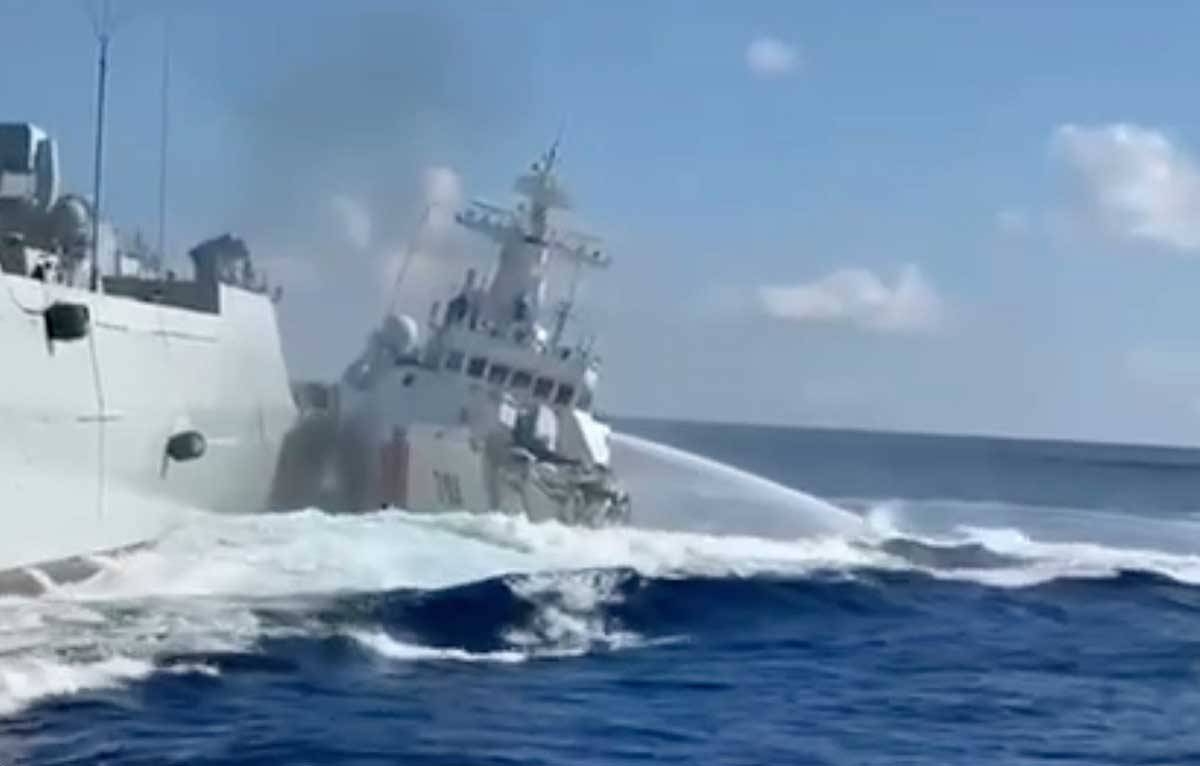
(UPDATE) NATIONAL Security Adviser Eduardo Año warned of escalating asymmetric threats that could undermine Philippine security, highlighting China’s recent maneuvers in the West Philippine Sea (WPS) as a pressing concern requiring coordinated international action.
Speaking at the Navigating Asymmetric Threats: Cross-Regional Strategies for Europe and the Indo-Pacific forum hosted by the Stratbase Institute and the European Council on Foreign Relations, Año said particularly alarming is Beijing’s plan to declare a marine reserve in Bajo de Masinloc, a disputed shoal well inside the Philippines’ exclusive economic zone.
He described the plan as a “coercive attempt” to assert territorial claims in Philippine waters and a direct challenge to international law.
“Such attempts tell the world that respect for international law and a rules-based order is now being put aside to give way to self-serving domestic laws,” Año said.
He said regional threats now extend well beyond traditional military confrontations. He cited the sabotage of undersea cables, state-sponsored cyber intrusions, disinformation campaigns, and the weaponization of trade and critical minerals as growing risks to archipelagic states like the Philippines.
“Tensions in the South China Sea, in the West Philippine Sea, echo in Europe’s energy and trade networks,” he said, emphasizing the interconnectedness of Indo-Pacific and European security.
Año called for robust cross-regional strategies, including safeguarding freedom of navigation, bolstering cybersecurity, diversifying supply chains, and enhancing cooperation on energy and critical infrastructure. He also urged closer coordination between Asean and its European partners to prevent escalation in disputed waters.
“Despite unprecedented risk, I am optimistic that our regions have the resources, the capacities and the will power to shape the future,” he said. “Europe and the Indo-Pacific must stand as guardians of the values we deeply share — democracy, multilateralism, transparency, freedom of navigation and free trade.”
French officials echoed Año’s call for deeper collaboration. RAdm. Guillaume Pinget, commander of the French Armed Forces in the Pacific, reaffirmed Paris’ commitment to Manila and the Indo-Pacific region.
Speaking at the same forum, Pinget cited France’s deployments, including the aircraft carrier Charles de Gaulle’s visit to the Philippines this year, as evidence of France’s capability to project “multi-domain effects” in support of regional security.
Pinget warned that asymmetric tactics threaten democratic institutions and economic stability, particularly for maritime nations like the Philippines.
France, he said, is working with regional partners to strengthen cybersecurity, resilience against hybrid threats and multilateral coordination, emphasizing approaches rooted in sovereignty, international law and partnership rather than bloc politics.
In a related development, visiting Chinese scholars and policy experts urged Manila to complement its security concerns with engagement on economic, cultural and historical fronts.
Speaking at “Newsmakers” hosted by The Manila Times columnist Ben Kritz, Ding Guo of the National Institute for South China Sea Studies, Su Hao of China Foreign Affairs University and international lawyer-investment banker Victor Zhikai Gao endorsed a binding Code of Conduct in the South China Sea to supplement the 2002 Declaration on the Conduct of Parties.
Ding argued that while sovereignty disputes remain unresolved, the Philippines and China could cooperate in “low-sensitive” areas such as environmental protection, maritime research, and search-and-rescue operations.
Su placed the maritime issue in a broader geopolitical context, noting opportunities for Asean states to engage in initiatives like the Shanghai Cooperation Organization, which he said fosters a more balanced global order.
Gao, focusing on economic collaboration, highlighted China’s capacity to support infrastructure and development projects in the Philippines.
“Connectivity is crucial — highways, railways, power. China has the capital, technology and experience to help the Philippines upgrade its economy,” he said.
Gao said centuries of peaceful interaction between the two nations could guide future cooperation.