

Rome is asking drivers to do something it has rarely demanded before—slow down.
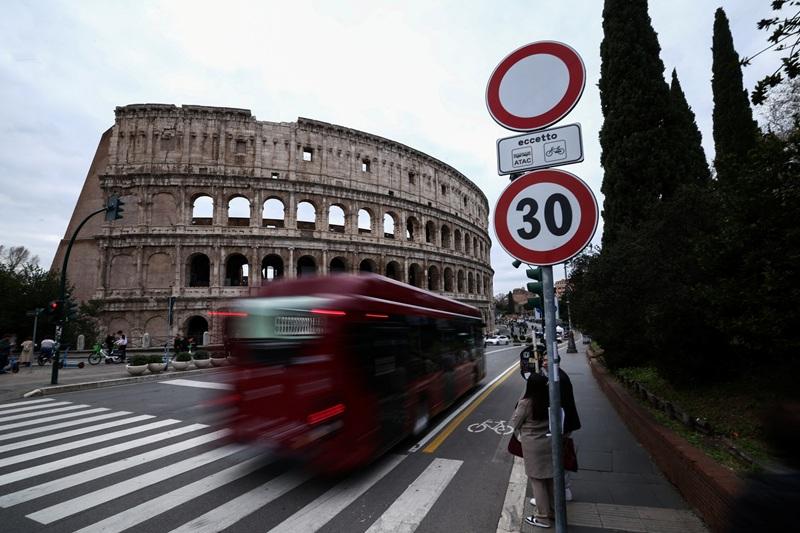
Starting Thursday, the Eternal City will enforce a 30 kph speed limit across its historic center, nearly cutting the previous 50 kph limit in half. The move places Rome among a growing list of European capitals choosing safety, health, and livability over speed.
For a city famous for fast, chaotic driving, the shift is a big one.
The new rule applies to streets packed daily with residents, tourists, buses, scooters, and cars—roads never designed for modern traffic volumes.
“These roads reflect a city built for cars that no longer exists,” said Rome’s transport chief, Eugenio Patanè, in an interview with Corriere della Sera.
And the stakes are high.
“Lower speeds save lives,” Patanè added, pointing to data showing that speeding plays a role in 7.5 percent of road accidents in the city.
Rome is not alone.
The capital now follows the path taken by London, Brussels, Paris, and Helsinki, all of which have adopted slower speed limits to make streets safer—often in the face of loud opposition from motorists.
Closer to home, the results have been striking.
In Bologna, Italy’s first major city to enforce a 30 kph limit in January 2024, road accidents fell by 13 percent, while fatalities dropped by nearly 50 percent within a year.
Rome’s leadership hopes to see the same.
Since taking office in 2021, Mayor Roberto Gualtieri has pushed for safer streets by expanding the use of speed cameras and urging residents to rely less on private cars—moves driven by growing concerns over road safety and pollution.
Those concerns are not abstract.
In November, Italy’s Supreme Court ruled that residents living along Rome’s congested ring road were entitled to €10,000 in compensation due to prolonged exposure to excessive noise and fine-particle pollution.
City officials say the new speed limit could reduce noise pollution in the historic center by around two decibels—a small number on paper, but a meaningful difference for people who live and walk there every day.
For Rome, this is not just about traffic.
It’s about reclaiming streets, protecting lives, and reshaping a city long dominated by cars—one slower kilometer at a time.