


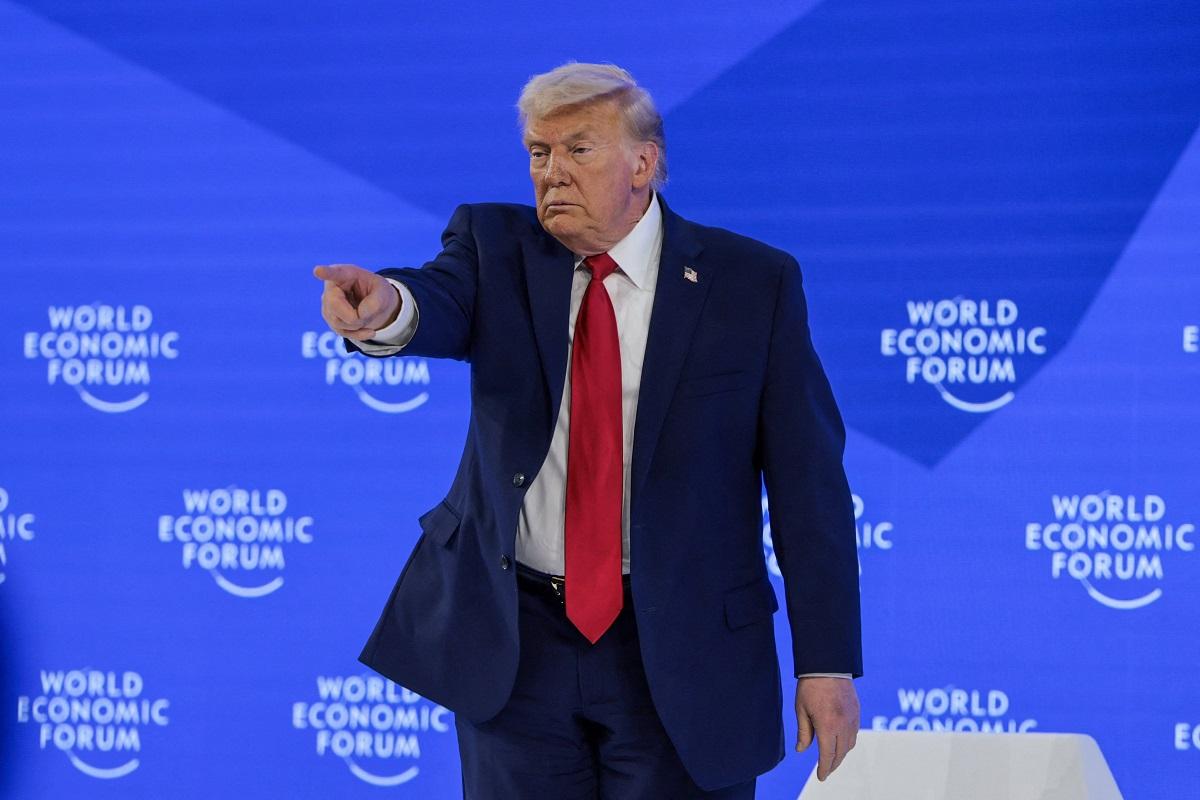
DAVOS, Switzerland — Standing before the world’s political and business elite, US President Donald Trump delivered a message that was firm, defiant, and unmistakably his own.
The United States, he said, will not use force to gain control of Greenland.
“People thought I would use force,” Trump told delegates at the World Economic Forum on Wednesday. “But I don’t have to use force. I don’t want to use force. I won’t use force.”
Still, his words offered little comfort to uneasy European leaders.
In a speech that stretched more than an hour, Trump insisted that no other nation can secure Greenland except the United States, doubling down on his long-standing interest in the Danish territory. While ruling out military action, he made clear he wants talks — and soon.
“I’m seeking immediate negotiations,” Trump said, once again raising the idea of a US acquisition of Greenland.
The tone of the speech was confrontational.
Trump openly scolded America’s European allies, accusing them of disloyalty and poor judgment on issues ranging from immigration to environmental policies and energy. His remarks, delivered with a sharp edge, further strained already fragile transatlantic ties.
Calling Denmark “ungrateful,” Trump brushed aside concerns, describing Greenland as a “small ask” — even referring to it repeatedly, and mistakenly, as Iceland. He argued that US control of the vast Arctic territory would pose no threat to NATO, despite Denmark being a key member of the alliance.
“We want a piece of ice for world protection,” Trump said bluntly. “And they won’t give it.”
The comments overshadowed what was meant to be a speech focused on the US economy, instead fueling anxiety among European leaders. NATO officials have warned that Trump’s Greenland strategy could disrupt the alliance, while Denmark and Greenland have tried to ease tensions by offering expanded US access and cooperation — without giving up sovereignty.
Inside the packed congress hall, hundreds listened closely at first. Others crowded into nearby lobbies, watching on screens or following along on their phones. But as the speech wore on, attention drifted. Conversations resumed. Phones went down.
Trump, marking the end of a turbulent first year back in office, once again dominated the Davos agenda — not with reassurance, but with a message that left allies uneasy and questions unanswered.
Force may be off the table.
But the pressure, clearly, is not.