


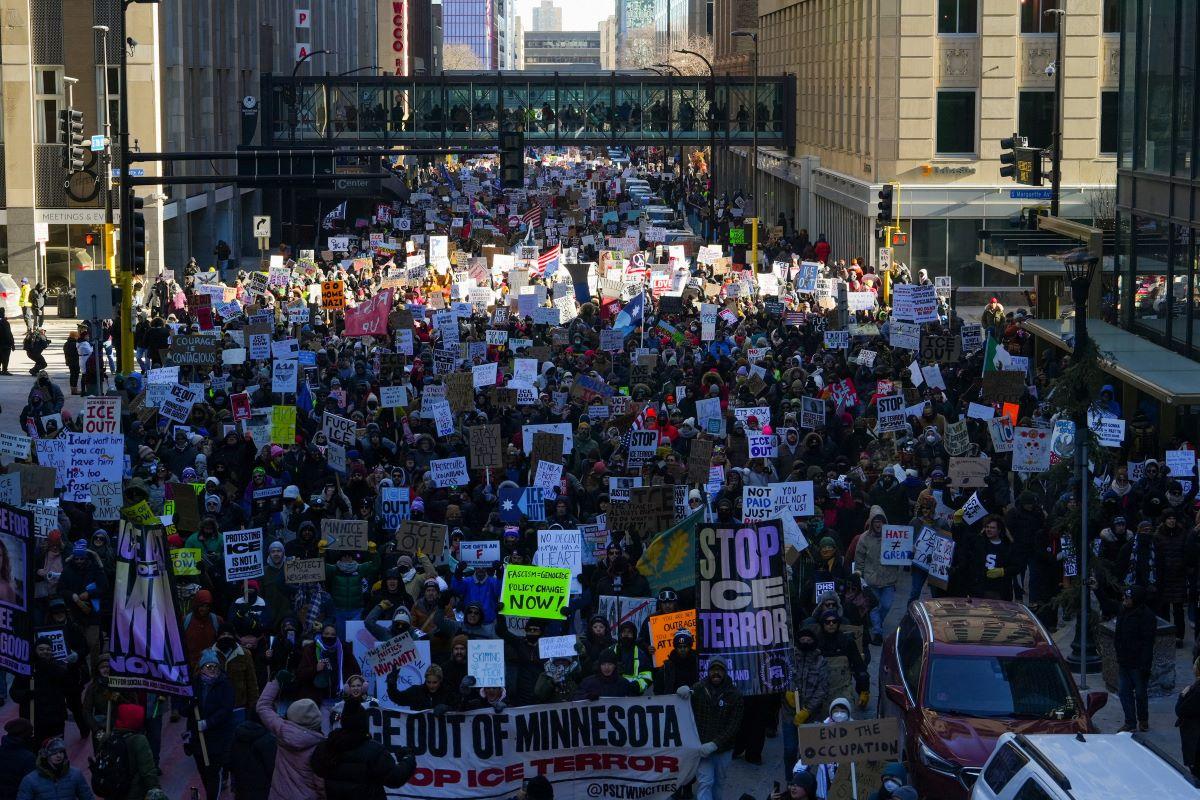
MINNEAPOLIS — The streets were cold.
But the anger—and the resolve—were unmistakable.
On Friday, thousands of protesters flooded downtown Minneapolis, while students across the United States walked out of classrooms in a powerful show of defiance. Their demand was clear: federal immigration agents must leave Minnesota.
The protests followed the fatal shootings of Alex Pretti and Renee Good, two U.S. citizens killed this month during federal immigration operations. For many, it was the breaking point.
From California to New York, students and teachers abandoned classes during a national day of protest. The message echoed across campuses and city streets:
Enough.
At the center of the outrage is Operation Metro Surge—a sweeping immigration crackdown ordered by President Donald Trump, which sent 3,000 federal officers into the Minneapolis area. Clad in tactical gear, the force now patrolling the city is five times larger than the Minneapolis Police Department.
In sub-freezing temperatures, families with small children, elderly couples, and young activists stood shoulder to shoulder downtown—protesting the surge and the tactics of U.S. Immigration and Customs Enforcement (ICE).
Among them was Katia Kagan, wearing a “No ICE” sweatshirt and holding a sign demanding agents leave the city.
She is the daughter of Russian Jewish immigrants.
“I’m out here because I’m going to fight for the American dream my parents came here for,” she said.
Nearby, Kim, a 65-year-old meditation coach, didn’t hold back.
She called the operation a
“full-on fascist attack of our federal government on citizens.”
In neighborhoods near where Pretti and Good were killed, about 50 teachers and school staff marched quietly—but firmly—through the streets.
Then came a moment that turned protest into tribute.
Rock legend Bruce Springsteen took the stage at a fundraiser for the victims, performing his new song, “Streets of Minneapolis.” The crowd listened in silence—some in tears.
And Minneapolis was just the beginning.
Organizers projected 250 demonstrations across 46 states, reaching major cities like New York, Los Angeles, Chicago, and Washington, D.C. The slogan was blunt:
“No work. No school. No shopping. Stop funding ICE.”
President Trump responded online, voicing strong support for Homeland Security Secretary Kristi Noem, despite growing calls for her resignation.
“She has done a really GREAT JOB!” Trump wrote, adding that the “border disaster” he inherited was now “fixed.”
But inside the federal government, cracks began to show.
The acting head of the Minneapolis FBI field office, Jarrad Smith, was quietly removed from his post and reassigned to Washington, according to sources. His office had been deeply involved in the federal surge and investigations tied to the shootings.
Meanwhile, former CNN anchor Don Lemon was arrested Friday over a protest inside a St. Paul church earlier this month. Charged by the Justice Department, Lemon pleaded not guilty.
“I will not be silenced,” he said.
“I look forward to my day in court.”
Fueling the fire, The New York Times reported that ICE agents were recently granted broader authority to arrest people without a warrant, expanding street-level sweeps nationwide.
Back in Congress, backlash threatened to trigger a partial government shutdown, as Democrats moved to block funding for the Department of Homeland Security.
Public opinion has shifted sharply.
Weeks of viral videos showing masked, heavily armed agents confronting civilians have driven approval of Trump’s immigration policy to the lowest level of his second term, according to a Reuters/Ipsos poll.
In response, Trump’s border czar Tom Homan was sent to Minneapolis, promising a return to more targeted operations.
But Minnesota Governor Tim Walz wasn’t convinced.
“The only way to ensure the safety of Minnesotans,” he said,
“is for the federal government to draw down their forces and end this campaign of brutality.”
Trump has sent mixed signals—saying he wants to “de-escalate,” then insisting there would be no pullback.
Elsewhere, the ripple effects continued.
Schools closed in Aurora, Colorado.
Classes were canceled in Tucson, Arizona.
Students marched in Chicago, Long Beach, and Brooklyn, carrying signs that read:
“Sanctuary campus.”
“Fascists not welcome.”
Across the country, a movement is rising.
Not quietly.
Not patiently.
But loudly—
and together.