


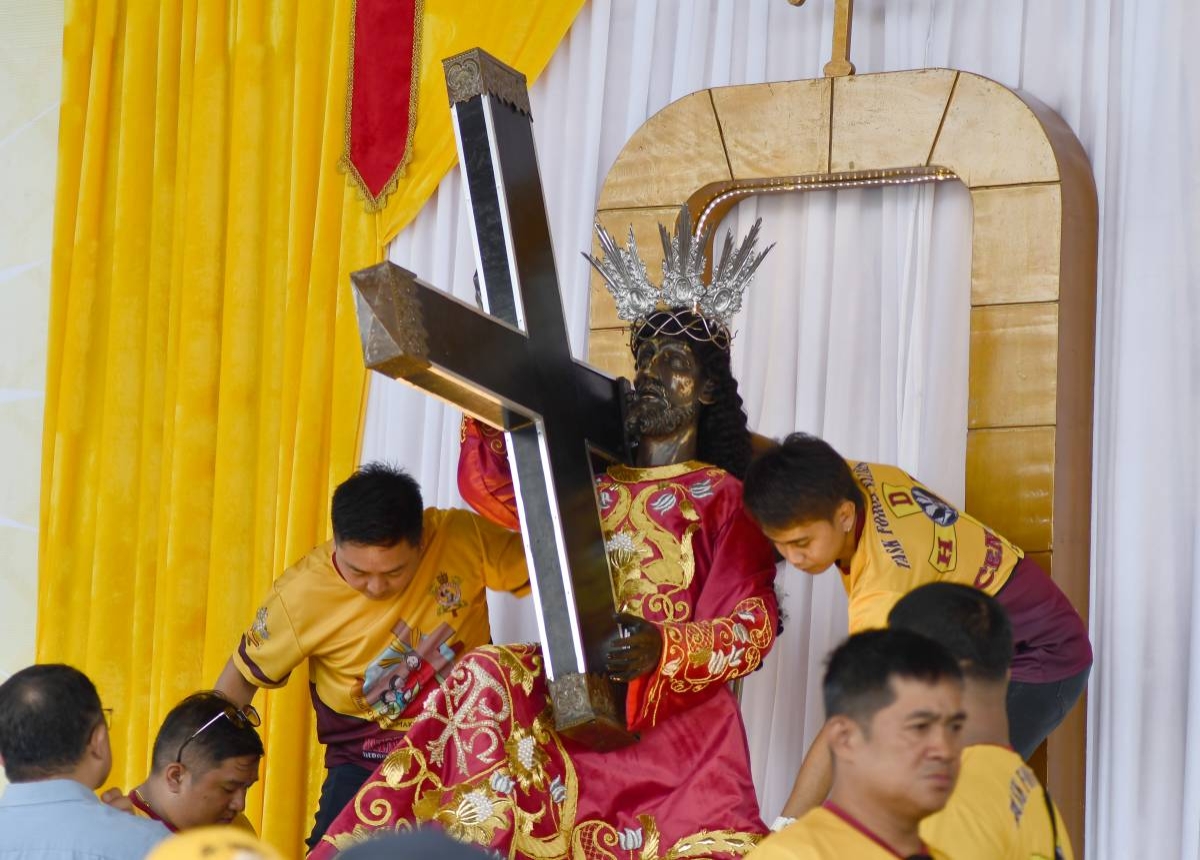
After more than 30 long, exhausting hours, the image of the Black Nazarene finally returned to Quiapo Church on Saturday morning — bringing to a close a procession marked by deep faith, sacrifice, and sorrow.
The Traslacion, which began at 3:59 a.m. on Friday, ended at 10:49 a.m. Saturday, according to the Manila Public Information Office.
That journey lasted one day, six hours, and 50 minutes — officially making Traslacion 2026 the longest in history.
It broke the previous record of 22 hours and 14 minutes, set back in 2012.
Along the way, tragedy struck.
Church officials confirmed that two devotees died during the procession, though no further details were given.
A slow, solemn journey
At 4 a.m. Saturday, the andas — the carriage bearing the image of the Nazarene — reached San Sebastián Church for the traditional “Dungaw.”
This sacred moment allows the Black Nazarene to “gaze” upon Our Lady of Mt. Carmel, as thousands stood in silence and prayer.
Authorities estimated that around 300,000 devotees gathered for the Dungaw alone.
From there, the procession inched forward.
By 8:07 a.m., the andas reached Hidalgo Street.
At 10:40 a.m., it arrived at Plaza Miranda.
Nine minutes later, the Black Nazarene finally entered Quiapo Church — greeted by cheers, tears, and prayers.
Millions on the streets
The sheer number of devotees was overwhelming.
The Manila Disaster Risk Reduction and Management Office recorded an accumulated total of more than 9.64 million people who joined the Traslacion from start to finish.
Quiapo Church placed the figure at 9.6 million.
The Philippine National Police, meanwhile, estimated at least 7.3 million devotees across Manila, based on drone footage and crowd estimates along the route.
Medical emergencies and exhaustion
The Philippine Red Cross reported treating 856 patients during the event.
Of these, 409 were minor cases, 13 were major, and 19 were transported to hospitals.
More than 2,200 devotees also received welfare assistance.
Nazareno 2026 spokesperson Fr. Robert Arellano said the slow pace of the procession was due to the massive crowd blocking the route.
“Another factor is when devotees climb the andas,” he explained.
“Despite our appeal not to climb it, people still do so as part of their devotion.”
Exhaustion, he added, also took its toll on both devotees and procession handlers.
A test of faith — and order
Despite the challenges, authorities described the event as largely peaceful.
Acting PNP chief Lt. Gen. Jose Melencio Nartatez Jr. praised the more than 18,000 police personnel deployed, including reinforcements from Central Luzon and Calabarzon.
“This is the longest Traslacion so far,” Nartatez said.
“And it is an impressive show of faith and devotion of millions of Filipino devotees.”
He added that for the police, the event was also “a remarkable display of discipline, perseverance, and commitment to serve and protect the people.”
In the end, Traslacion 2026 stood as a powerful reminder of Filipino faith —
a journey marked by devotion, endurance, loss, and unity —
one that will be remembered not just for its length, but for the millions who walked, prayed, and endured together.