


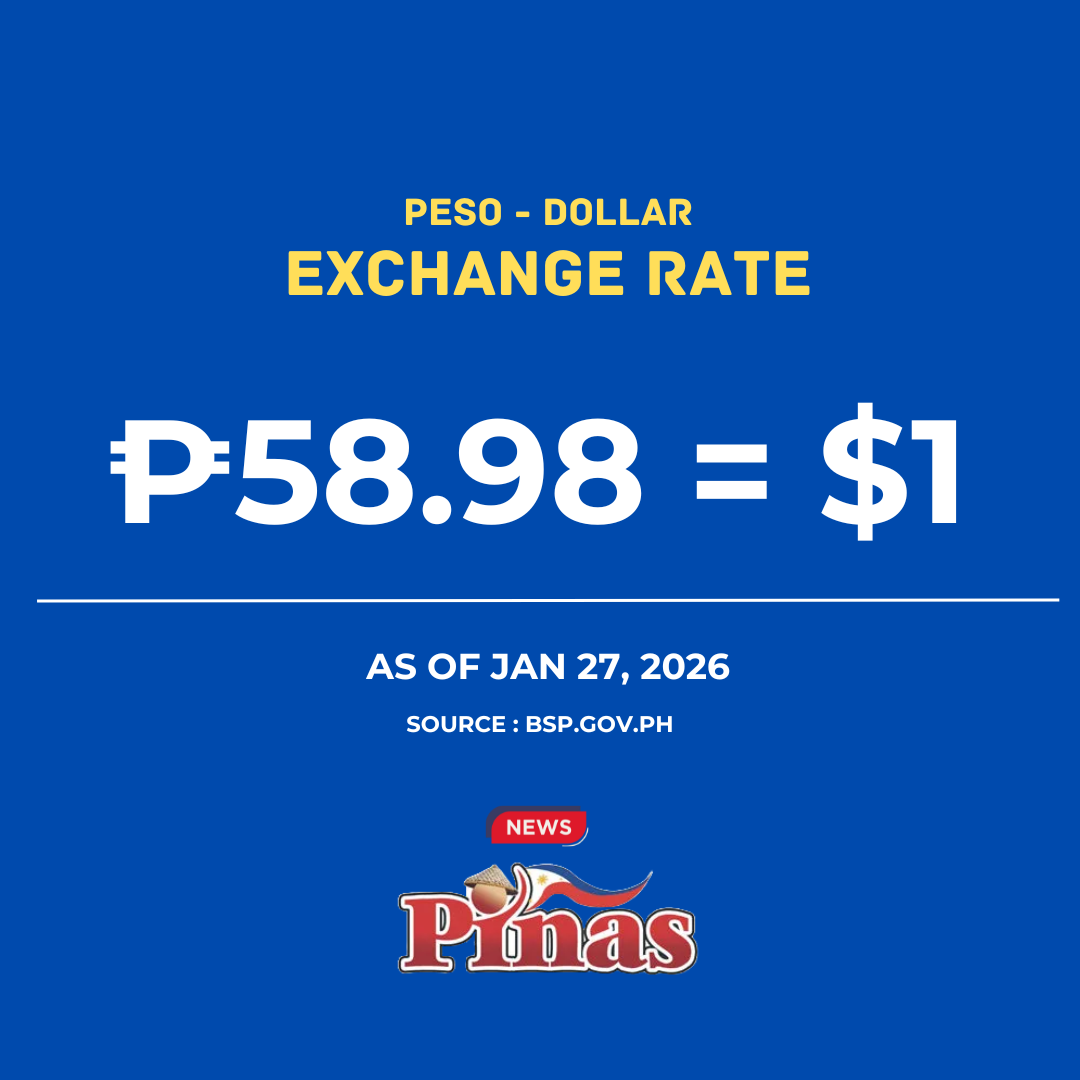
The Philippine peso woke up today facing a familiar reality.
Pressure.
According to the Bangko Sentral ng Pilipinas (BSP) Reference Exchange Rate Bulletin dated January 27, 2026, the peso continues to trade weak against major global currencies—led, as always, by the US dollar.
Let’s break down what’s happening.
Slowly. Clearly. One currency at a time.
Peso vs US Dollar (USD)
At ₱58.98 per dollar, the peso remains fragile.
This level reflects persistent global uncertainty, strong US economic data, and steady demand for the dollar as a safe haven.
For ordinary Filipinos, this means more expensive imports, higher fuel costs, and continued pressure on prices.
Peso vs Japanese Yen (JPY)
The yen stands at ₱0.38 per ¥1.
While Japan’s currency remains weak globally, the peso still struggles to gain meaningful ground—showing that Asia-wide currency pressure remains intense.
Peso vs British Pound (GBP)
The pound trades at a heavy ₱80.70 per £1.
This makes the UK one of the most expensive destinations for peso holders, driven by stubborn inflation and tight monetary conditions in Britain.
Peso vs Hong Kong Dollar (HKD)
At ₱7.56 per HK$1, the Hong Kong dollar stays stable—anchored to the US dollar and moving in near lockstep with it.
Peso vs Swiss Franc (CHF)
The franc now costs ₱75.94.
As global tensions rise, investors continue to flock to Switzerland’s safe-haven currency—leaving the peso trailing behind.
Peso vs Canadian Dollar (CAD)
The Canadian dollar trades at ₱43.03.
Commodity prices and steady North American demand keep the loonie firm, limiting peso recovery.
Peso vs Singapore Dollar (SGD)
At ₱46.45, the Singapore dollar reflects economic strength and investor confidence—two things the peso continues to chase.
Peso vs Australian Dollar (AUD)
The Aussie dollar stands at ₱40.79, supported by commodities and China-linked trade recovery.
Peso vs Bahrain Dinar (BHD)
One of the strongest currencies globally, the Bahrain dinar soars at ₱156.45.
A reminder of how oil-backed currencies remain in a league of their own.
Peso vs Saudi Riyal (SAR)
The riyal trades at ₱15.73, also benefiting from oil stability and its peg to the US dollar.
Peso vs Brunei Dollar (BND)
At ₱46.27, the Brunei dollar mirrors the Singapore dollar—steady, disciplined, and resilient.
Peso vs Indonesian Rupiah (IDR)
The rupiah remains low at ₱0.0035, but volatility in emerging markets continues to affect regional currencies—including the peso.
Peso vs Thai Baht (THB)
The baht trades at ₱1.89, as Thailand balances tourism recovery with global economic headwinds.
Peso vs UAE Dirham (AED)
At ₱16.06, the dirham reflects Middle East stability and its firm US dollar peg.
Peso vs Euro (EUR)
Closing the top currencies list, the euro now stands at ₱70.08.
Despite slowing growth in Europe, the euro remains strong against the peso—highlighting widening currency gaps.
BSP Key Rates Snapshot
-
BSP Reference Rate: ₱58.95
-
Buying Rate: ₱58.70
-
Selling Rate: ₱59.20
-
PDS Closing Rate (Jan 26): ₱58.97
Gold and silver prices remain elevated, another sign that investors are still cautious—and still seeking safety.
The Bottom Line
The peso is holding—but barely.
Against the world’s top currencies, the message is clear:
Global strength remains elsewhere, while the peso continues to fight an uphill battle.
For now, every centavo counts.