


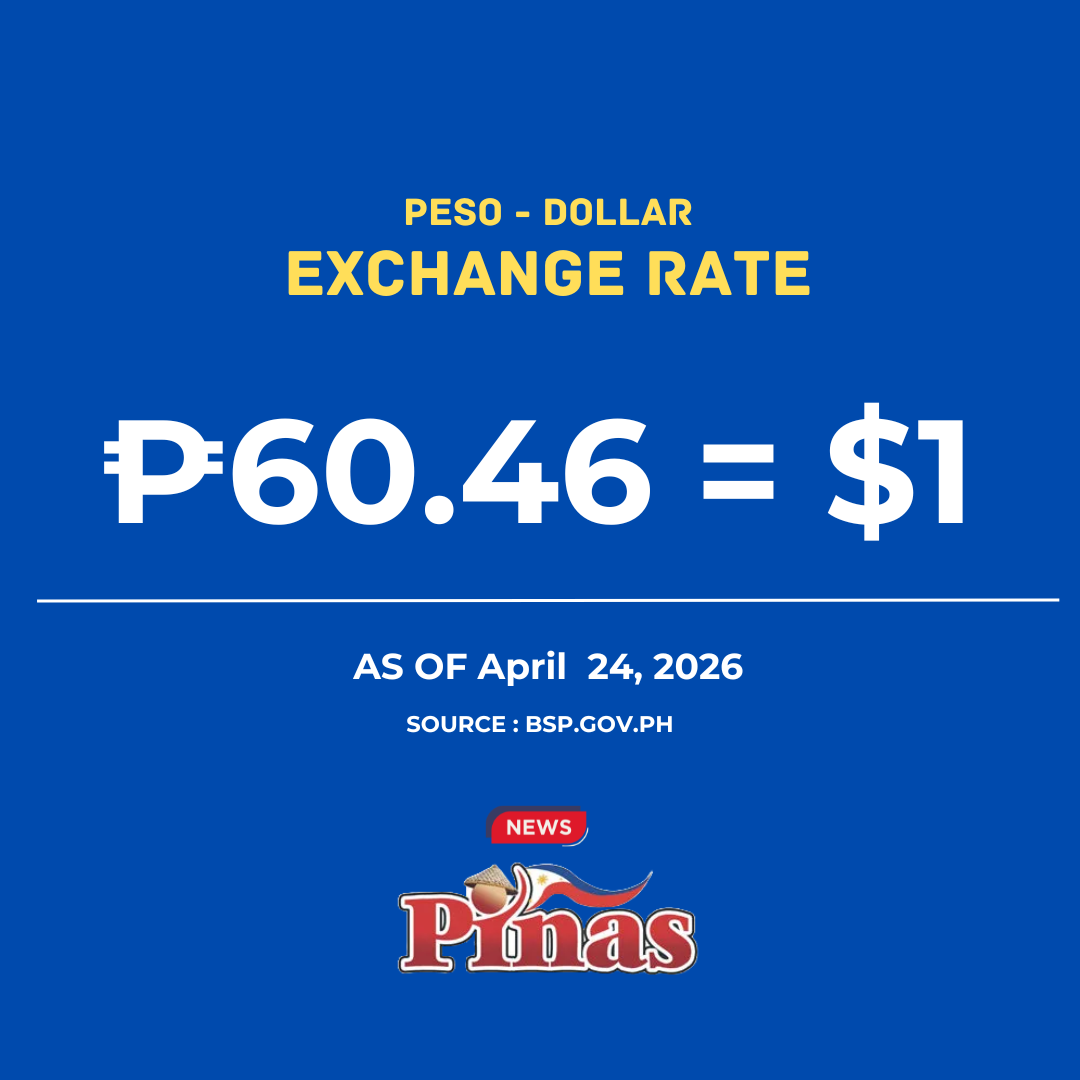
The numbers are in…
And they tell a story that affects every Filipino — whether you feel it or not.
From remittances…
to travel…
to the rising cost of goods…
It all comes down to one thing:
The value of the peso.
As of April 24, 2026, the Philippine peso stands at:
₱60.50 for $1
A level that feels… heavy.
Because every movement of the dollar
pulls everything else with it.
💵 The Dollar Still Leads
The US dollar remains the anchor.
At ₱60.50, it continues to dominate global trade —
and for many Filipinos abroad, this means stronger remittances.
But here’s the other side…
A stronger dollar also means
more expensive imports.
Fuel. Food. Essentials.
Everything feels it.
💷 Strong Currencies, Higher Pressure
Some currencies are even stronger than the dollar —
and that puts more pressure on the peso.
- British Pound (GBP): ₱81.45
- Swiss Franc (CHF): ₱76.93
- Euro (EUR): ₱70.66
These currencies are holding firm.
And when they rise…
the peso feels smaller.
💴 Asia’s Mixed Movement
Closer to home, the picture shifts.
Some currencies remain affordable —
but still impact trade and travel.
- Singapore Dollar (SGD): ₱47.31
- Hong Kong Dollar (HKD): ₱7.72
- Chinese Yuan (CNY): ₱8.84
- Japanese Yen (JPY): ₱0.37
The yen remains weak…
while regional currencies stay steady.
A quiet balance — but not without tension.
🛢️ Middle East Power Currencies
For OFWs in the Middle East,
these numbers matter deeply.
- Bahrain Dinar (BHD): ₱160.21
- UAE Dirham (AED): ₱16.46
- Saudi Riyal (SAR): ₱16.12
These currencies remain strong —
meaning remittances still carry weight.
But behind every peso sent home…
there’s sacrifice.
🌏 Other Key Global Currencies
Across the world, the peso stands against:
- Canadian Dollar (CAD): ₱44.15
- Australian Dollar (AUD): ₱43.11
- New Zealand Dollar (NZD): ₱35.39
- Thai Baht (THB): ₱1.86
- Indonesian Rupiah (IDR): ₱0.0035
Some strong.
Some fragile.
But all connected… in one global system.
💬 What This Means — Right Now
These aren’t just numbers.
They are real-life impact.
When the peso weakens:
- Imported goods become more expensive
- Travel costs rise
- Businesses adjust prices
- Families stretch budgets further
But there’s also a quiet upside…
For millions of OFWs,
a stronger dollar means more pesos sent home.
⚖️ A Delicate Balance
The Bangko Sentral ng Pilipinas continues to monitor the situation closely.
With a buying rate of ₱60.25
and a selling rate of ₱60.75,
the gap reflects a market still searching for stability.
And as the world shifts…
so does the peso.
Sometimes slowly.
Sometimes suddenly.
But always… with impact.
Because in the end,
this isn’t just about currency.
It’s about every Filipino life tied to it.